📈
Tracking
How to track sobriety (and what to actually record)
Days are the easy part. What else is worth writing down, and why.
The best sobriety tracking apps all count days, so that is not the thing to compare. The category really splits on one question: do you need a record or do you need something to do when a craving hits? Nomo and Sober Time are the strongest dedicated counters. I Am Sober has the most people in it. Reframe is the most substantial programme. Loosid is the one for a social life built on alcohol. SoberLine — ours — is built around the craving moment, and is iPhone-only.
Search for the best sobriety tracking apps and you get roughly the same eight names in a different order every time, usually from a treatment centre with an advertising relationship. That is why so many people add "reddit" to the end of the query. This page is organised the other way round: first what actually separates an app you still open on day 90 from one you delete in week two, then which app does which of those things well. If you already know what you want, SoberLine is here.
Almost every sobriety app counts days. Counting days is the easy part — a notes app does it. These are the differences that actually show up in whether you keep using one.
This is the single biggest split in the category. Most apps are records: you open them, you see a number, you feel briefly good, you close them. A craving at 9 p.m. is not a record-keeping problem. Some apps have something to do in that moment — breathing, urge surfing, a game demanding enough to occupy your attention for the three to ten minutes a craving actually lasts. Most do not. Decide which kind you need before you compare anything else.
Day 47 stops being motivating around day 20. What keeps working is a count attached to consequences: money that came back, a physical recovery stage you have reached, a milestone you earned. An app that shows only a number has a shelf life.
You will, or you might, and the app's answer to that is a design decision with real consequences. Some reset the counter and wipe everything behind it, which is the moment people delete the app and do not come back. Others log the slip and keep the history. Look for this before you commit — it is hard to find out until it happens to you.
Plenty of people are not quitting; they are trying to drink less. An abstinence-only app makes that person feel like they are using it wrong. A moderation-only app has nothing for the person who has stopped. A few do both.
Community ranges from a full social network with profiles to an anonymous feed to nothing at all. There is no right answer — but if you want contact without a meeting and without your real name attached, that narrows the field fast.
This one gets skipped and it should not. You are about to type the most private thing in your life into a phone. The questions worth asking: does it need your real name, is the community anonymous or a profile-based social network, can you export or delete your history, and does it work if you never connect it to anything. The answers vary enormously across this category, and they are the hardest thing to change your mind about later.
Deliberately not ranked. The six criteria above weigh differently for different people, so each app is described by what it is best at.
The biggest name here and, for a lot of people, the right answer. A large and active message board, daily pledges, and a skills workbook covering things like boundaries and coping strategies. It can track several addictions at once, which matters if alcohol is not the only thing you are stopping. If you want the most people in it, this is it. How it compares on structure.
One screen, one very large number, several goals if you want them, plus a community section. It does not try to be a programme. If what you want is a clean, legible day count and nothing else asking for your attention, a focused app beats a feature-rich one you find cluttered.
Built by someone in recovery, and unusual in letting you run several sobriety clocks side by side. It adds accountability partners, shareable chips and journaling. If you are tracking more than one thing, it handles that better than anything here, including us. Nomo alternatives covers the rest.
Closer to a structured programme than a tracker: a large library of research-backed exercises, mindfulness and meditation content, craving tracking, a community forum, live group sessions with certified coaches, and optional one-to-one coaching. Aimed as much at drinking less as at stopping. If you want reading, lessons and coaching rather than a counter, it is the most substantial option in the category.
Sober-day tracking plus a genuine social layer: an open community, sober events, and a dating feature. If your problem is that your entire social life runs on alcohol and you do not know a single sober person, that is a real problem and this is the app built for it. We have nothing that competes with it on that axis.
Built around mindful drinking and moderation rather than abstinence: planning, tracking against a target, and nudges. If you have decided you are not quitting, an app designed around that goal will treat you better than an abstinence app with a moderation setting.
A note on Sober Grid, since people still search for it: pulled from the App Store in 2023, dark since 2025, no announcement. Loosid is the closest thing to its social feed, and what to use instead of Sober Grid covers the rest, including your data.
Ours. The reason it exists is criterion one: a Panic Button that runs guided 4-4-4 breathing, urge surfing, your own reasons-why, and distraction games, in the minutes when a number on a screen is useless. Around it sits a live day counter, a Recovery Tree that grows with your dry days, a running money-saved total, a seven-stage health timeline, 22 milestones, and a 30-day path in three phases. It handles both goals — quit completely or set a daily limit — switchable in Settings. And a slip restarts the counter without wiping the milestones, savings or history behind it.
Where it loses: three places, and we would rather say them than have you find out in week two. It is iPhone and iPad only — if you are on Android, stop reading this entry. There is no live human coaching: the community is anonymous and asynchronous, so if you want scheduled sessions with a certified coach, Reframe does that and we do not. And it tracks alcohol — if you are stopping more than one thing at once, Nomo's parallel clocks are the better tool. The full version is in our honest SoberLine review, including who it does not suit.
Whichever you pick, the app is scaffolding, not the plan. The plan is a realistic structure for the drinking hours.
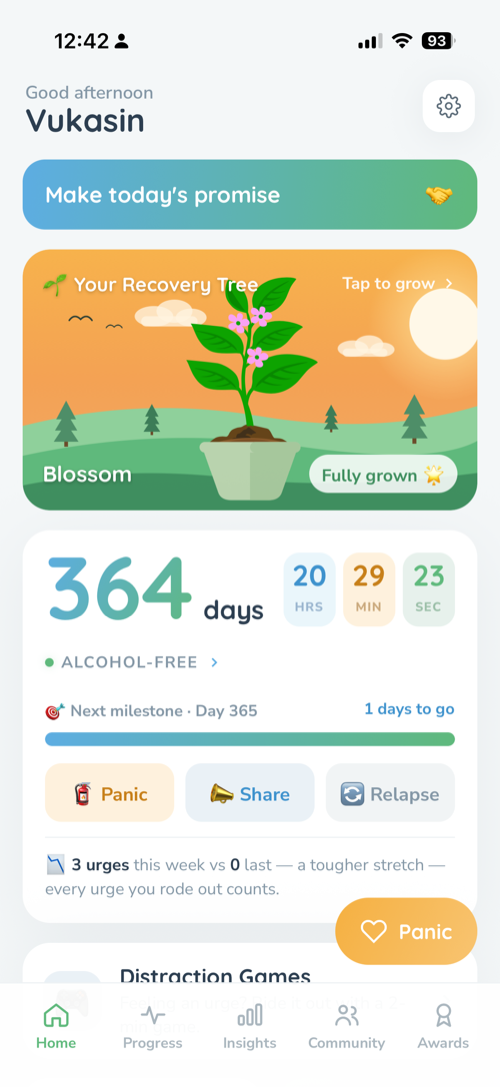
If criterion one is the one that matters to you, this is the screen that answers it:
Days are the easy part. What else is worth writing down, and why.
What it does, what it does not, and who it suits. By the people who built it.
Structure beats willpower: the complete guide.
Free to download, with a free trial for new members. You're not alone in this.