SoberLine Review: What It Does and What It Doesn't
Updated August 2026 · 5 min read · By the SoberLine team
The short answer:
SoberLine is free to try. It is an iOS-only sobriety tracker built around a 24/7 Panic Button for cravings, with a live day counter, a Recovery Tree, money saved, a seven-stage health timeline and a 30-day path around it. It handles both goals — quit completely or set a daily limit — and a slip restarts the counter without wiping the milestones behind it. It is not treatment, there is no Android version, and it cannot keep you sober on its own.
This is a SoberLine review written by the people who built SoberLine,
which is a conflict of interest, so it is organised around the questions people actually
ask before paying rather than the ones we would enjoy answering. If you want a version with
rivals in it, we also wrote an
honest comparison of the sobriety apps
worth considering — including the two that will do more for you for free.
If you already know what you want, SoberLine is on the App Store.
Is SoberLine free?
Free to download and free to try. The whole app is open when you start — the counter,
the Panic Button, the 30-day path, the community, all of it. Nothing is held back behind a
higher tier or drip-fed to you over the first week.
Everything below is what you actually get, followed by the things it deliberately does
not do. The full terms are in our terms of use.
What SoberLine actually does
It is built around one idea: a day counter is useless at the moment you most need help.
So the centre of the app is a 24/7 Panic Button — one tap gives you guided
4-4-4 breathing, urge surfing, your own written reasons for stopping, and distraction games
designed to occupy the
three to ten minutes a craving
lasts.
Around it sits the tracking: a live day counter, a Recovery Tree that grows with your
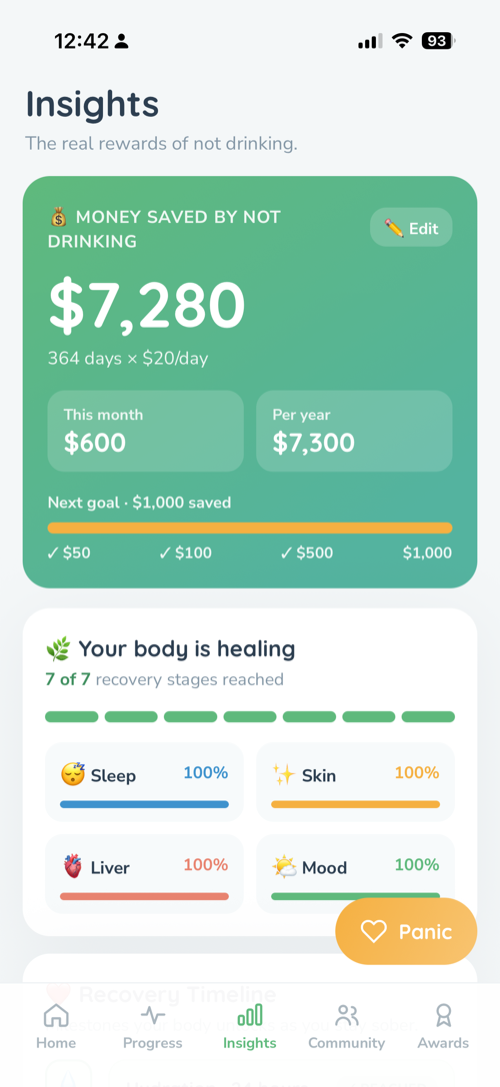
dry days, a money-saved total based on the spending you entered, a seven-stage health
timeline and 22 milestones. Plus a 30-day path in three phases with daily lessons and
journaling, a habit tracker aimed at the evening drinking ritual, a craving log that
surfaces your triggers, one-tap texting to a support person, and an anonymous community.
Two design decisions are worth calling out because they are unusual. First, it handles
both goals: quit completely, or set a daily limit and count alcohol-free
days, switchable in Settings. Second, a slip restarts the day counter but keeps
everything else — milestones, savings and history stay. You are not starting over.
What SoberLine does not do
Being straight about the limits is the whole point of a page like this.
It is not treatment. No clinicians, no therapy, no medication
management, no medical supervision. It is a wellness tool and it does not pretend to be
anything else.
There is no Android version. iPhone and iPad only, iOS 16.4 or
later. We are not going to promise you a date.
No live coaching or human meetings. The community is anonymous and
asynchronous. If you want scheduled group sessions with a certified coach, other apps do
that and we do not.
The money figure is your own number. It is based on the spending you
entered during onboarding, in USD. It is a reflection of what you told it, not an
independent measurement.
It cannot keep you sober. It gives structure and something to hold at
9 p.m. The plan is still yours to build.
Who it suits, and who it does not
Worth being blunt, because the wrong fit is nobody's win.
It suits you if the evenings are the problem. The whole app is built
around having something to do at the crest of an urge, rather than a number to look at
afterwards. If your difficulty is the 9 p.m. hour, that is the axis we chose.
It suits you if you are not sure you are quitting. Cut-down mode is a
first-class path, not a consolation setting — run a daily limit and count alcohol-free
days instead of a streak, and switch later if you want to.
It suits you if you have slipped before and it wrecked you. The
relapse behaviour is a deliberate design decision: the counter restarts, the record does
not. If losing a streak is what made you delete a tracker before, that matters more than
any feature list.
It does not suit you if what you need is people. The community here
is anonymous and asynchronous. If you need a room with faces in it, a
support group will do more for you
than we will, and we would rather you went.
It does not suit you if you are on Android. Nothing we can do about
that today. If you landed here after Sober Grid shut down,
the apps that replaced it include several
on both platforms.
Privacy
You can use SoberLine anonymously — no real name required, and the community is
anonymous by design. We do not sell your information, and you can export or delete it. The
specifics are in the privacy policy.
A medical note: SoberLine is a wellness tool, not medical care. If you
drink heavily or daily, stopping suddenly can be dangerous — talk to a doctor first. In
the US, call the SAMHSA
National Helpline at 1-800-662-4357 (free, 24/7), or dial 988 in a crisis.
What it looks like
The tracking side of the app, which is what most people open it for on a normal day:
A live sober day counter, down to the hour
Money saved, based on the spending figure you entered
A seven-stage health recovery timeline and 22 milestones
A craving log that surfaces the triggers behind your urges
Frequently asked questions
SoberLine is free to download and free to try. The whole app is open when you start — the day counter, the 24/7 Panic Button, the 30-day recovery path and the anonymous community — rather than being drip-fed or held back behind a higher tier.
No. SoberLine is iPhone and iPad only, and needs iOS 16.4 or later. There is no Android version and we won't promise a date for one. If you're on Android, our comparison of sobriety apps covers several that are available on both platforms.
No, and it does not pretend to be. There are no clinicians, no therapy, no medication management and no medical supervision — it is a wellness tool that gives structure and something to do when a craving hits. If you drink heavily or daily, talk to a doctor before quitting, because withdrawal can be dangerous.
The day counter restarts, but your milestones, savings total and logged history stay exactly where they were. That is a deliberate design decision — losing everything is what makes people delete a tracker and never come back. What to do after a relapse covers the rest.