🤝
Support
I can't stop drinking: what to do right now
If you keep trying to stop and can't, you're not broken. Concrete steps for tonight.
What to do after a relapse, in order: stop now rather than tomorrow, look after your body, and make no judgements about yourself tonight. In the morning, write down the chain — what happened in the hour before, what state you were in, where the earlier decision point was — and change one specific thing. The day count resets; the money, the physical repair and what you now know about your triggers do not.
Almost everything written about what to do after a relapse is aimed at someone who has a treatment team to call. If it is late, you drank, and phoning a rehab is not something you are going to do tonight, this is the version for you. It has two parts: the next few hours, and the next morning. SoberLine restarts the counter without erasing what you built, which is the same principle as everything below.
One drinking day is a bad day. One drinking day plus the story you tell yourself about it is how people lose a month.
Relapse researchers have a name for the mechanism: the abstinence violation effect. Having broken a rule you set, the mind reclassifies you — not "I drank tonight" but "I am someone who cannot do this" — and once the rule is already broken, there is no longer a reason to stop at one. The damage from most slips is not the alcohol. It is the four days after it.
So tonight, in order:
The morning after is where a slip either becomes information or becomes a spiral. The difference is the question you ask. "What is wrong with me" produces nothing usable. "What was the chain" produces a plan.
Write down the sequence, working backwards from the first drink:
That is a craving log entry, written late. Keeping one before the fact is the difference between finding this pattern once and finding it in advance.
Not "try harder". One structural change aimed at the chain you just wrote down. If the trigger was arriving home to an empty house at 6 p.m., the fix lives at 6 p.m. — not at 9, when the urge arrives. If it was a bottle in the flat, the fix is the shopping trip. If it was tiredness, the fix is the bedtime.
One change, aimed precisely. A relapse that produces a single structural fix has bought you something. The seven-step plan is largely a list of these fixes, and this is the honest way to work through it: one slip at a time, patching the specific hole each one reveals.
The day counter resets. That is arithmetic. But almost nothing else does.
The money you did not spend is still not spent. The physical repair from your longest stretch happened, and the second run at it starts from a better baseline than the first. You now know one of your triggers precisely, which you did not before. And you have proof you can go that many days, which is a fact about you that a single evening does not revoke.
Day one after a relapse is not the same as day one at the beginning, and treating it as though it were is the reason people who slip at day 90 sometimes do not come back for a year. You are not starting over. You are continuing, with better information.
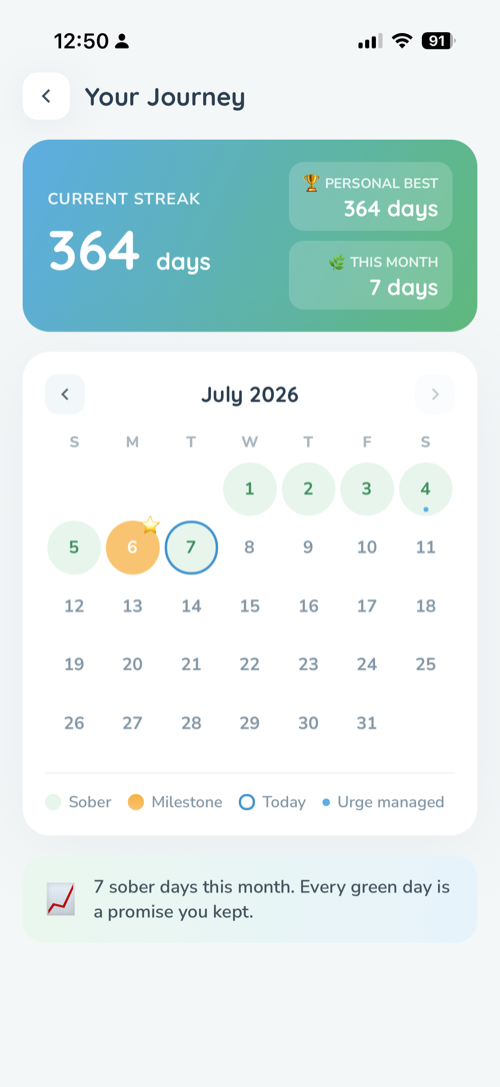
The app is built around this exact idea — a slip restarts the count, not the record:

If you keep trying to stop and can't, you're not broken. Concrete steps for tonight.
Getting sober and staying sober are different problems. This one is about the second.
Days are the easy part. What else is worth writing down, and why.
Free to download, with a free trial for new members. You're not alone in this.