🌱
The full plan
How to stop drinking: a realistic 7-step plan
Structure beats willpower: the complete guide.
If you keep thinking “I can't stop drinking”, you're not weak and you're not alone. Trying to stop and failing, over and over, usually means the approach was wrong-sized, not that you can't do it. Tonight, you don't have to fix everything; one small step counts. This page gives you the next 24 hours, then the next 30 days.
If you found this page late at night, maybe with a drink nearby, start here: typing those words into a search bar takes more honesty than most people ever bring to their drinking. Nothing about you is broken. This page won't lecture you, diagnose you, or ask you to promise anything forever. It will tell you what this feeling actually means, what to do before you go to sleep, and what to try when "just stopping" hasn't worked.
Wanting to stop and not stopping is not a mystery, and it's not a verdict on your character. It's the textbook signature of a habit loop that has outgrown willpower. Over time, your brain learned a simple prediction: trigger → drink → relief. Stress fires it. A time of day fires it. An empty evening fires it. And once it fires, it runs automatically, which is why the decision you made this afternoon keeps losing to the urge that arrives at nine o'clock.
Here's what that means in practice: the problem was never that you don't want it enough. You can want it desperately and still lose to a loop, because loops don't listen to wanting. Enormous numbers of people are quietly stuck in exactly this place: good, capable people who keep making a sincere decision and keep watching it dissolve. It's common. It's treatable. And it says nothing, nothing, about your worth.
You don't need a grand plan tonight. Grand plans made at midnight rarely survive breakfast anyway. What helps is a handful of tiny, physical steps, each one small enough to actually happen:
That's it. That's the whole assignment for tonight.
Before the 30-day part, one honest question matters, because it changes what "step one" should be. Some signals suggest your body, not just your habits, has adapted to alcohol:
This is not a diagnosis; it's a triage hint. The more of these you recognize, the more a doctor should be part of your plan, ideally before you stop abruptly, because alcohol withdrawal can be medically dangerous and a doctor can make it safe and far more comfortable. Dependence is a physiological state, not a moral one. Seeing a doctor about it is exactly as shameful as seeing one about blood pressure, which is to say, not at all.
Willpower is a decision system: slow, deliberate, easily tired, worst late in the day, precisely when drinking hours begin. Cravings come from a prediction system: fast, automatic, and older than language. When the two collide at 9 p.m. after a hard day, the outcome is nearly rigged. Every failed attempt you're carrying was most likely a willpower-only attempt: one system fighting alone against the part of the day that was purpose-built for drinking.
The fix isn't more grit. It's changing the terrain: reshaping the hours the loop lives in, planning for cravings instead of being ambushed by them, and getting other people and, when indicated, medicine on your side. That's a plan, not a personality upgrade, and we've laid the whole thing out in how to stop drinking: a realistic 7-step plan.
Think of your options as a ladder, from self-directed to professional. You start on whatever rung fits tonight, and you climb if a rung doesn't hold (climbing is wisdom, not failure):
If you're reading this with a drink already gone, hear this clearly: a slip is not the end of an attempt. The real damage rarely comes from the slip itself. It comes from the story told afterward: I've ruined it, might as well keep going, I'll start fresh Monday. That story is optional, and it's false.
Restart the same day, not Monday. Drink some water, write the one-sentence note, text the one person. A slip is data: it tells you exactly where your plan needs a reinforcement. And everything you've learned and every hour you've stayed sober before tonight still counts. People who make it are almost never the ones who never slipped. They're the ones who restarted quickly, without the self-punishment tour.
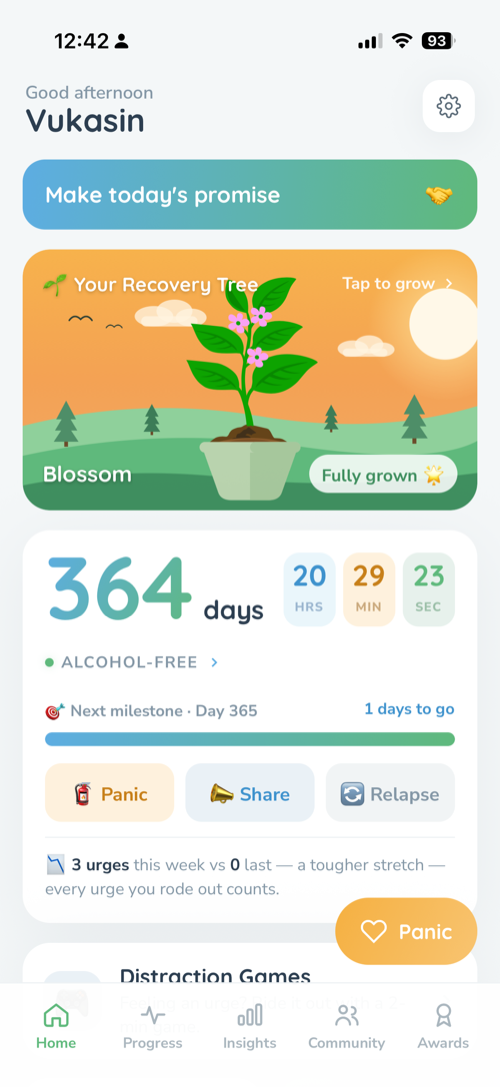
An app is not treatment, and this one won't pretend to be. What SoberLine offers is structure for the hours in between, the ones where deciding isn't enough:
Structure beats willpower: the complete guide.
What to do in the minutes when the urge peaks: at home, at work, or out with friends.
Meetings aren't the only door: the approaches that work without them.
Free to try. You're not alone in this.