Updated July 2026 · 7 min read · By the SoberLine team
The short answer:
Yes. Plenty of people work out how to quit drinking without AA, and plenty more work out how to stay sober without AA after they have stopped. What AA provides (accountability, community, ritual, and a plan) can be assembled from other pieces: structure you follow daily, craving tools, people who know what you're doing, and honest tracking. The method matters far less than whether you actually use it.
Tell someone you're quitting drinking and there's a good chance the first suggestion you hear is a meeting. It's well-meant advice. Alcoholics Anonymous has helped an enormous number of people, and if it works for you, this page isn't here to talk you out of it. But maybe you've been to a meeting and it didn't land. Maybe the spiritual framing isn't yours, the schedule doesn't fit your life, or you simply want to do this privately. None of that disqualifies you from getting sober. It just means you need a different container for the same work.
Why AA isn't the only way
Recovery research has been consistent on one point for decades: there are many routes out of problem drinking. People stop with formal treatment and without it, with groups and without them, gradually and overnight. Plenty of people who resolve a drinking problem never attend a mutual-help meeting at all. They change through therapy, medication, a shift in circumstances, or a self-directed decision they actually stuck to.
That's not a knock on AA. Twelve-step programs are free, available almost everywhere, and genuinely powerful for the people they fit. But fit is the operative word. Some people walk into a church basement and feel instantly at home; others feel like they're wearing someone else's coat. Recovery methods aren't a moral hierarchy. The best method isn't the most famous one or the most demanding one. It's the one you'll still be using three months from now.
So the honest question isn't "is AA good?" It's "will I show up for this, repeatedly, on the days I don't feel like it?" If your answer for AA is no, your job isn't to force it. Your job is to find the thing you'll say yes to.
What AA actually gives people
Before you skip the meetings, it's worth being precise about what happens in them, because whatever replaces AA has to do the same jobs. Strip away the specifics, and AA provides four functions.
Accountability. Someone notices whether you drank this week. You say your count out loud. The gap between "I'm quitting" and "I told people I'm quitting" is enormous.
Community. A room of people who don't need the backstory explained. Shame shrinks in company; it grows in isolation.
Ritual. Same day, same time, same chairs, chips at milestones. Ritual automates the decision to keep going, so you don't have to re-decide it every day.
A plan. The steps, the sponsor, the literature. There is always a concrete next thing to do, which matters most in the moments when your own judgment is wobbling.
Here's the part most solo attempts miss: quitting without AA doesn't mean quitting without these four things. It means sourcing them somewhere else. People who struggle "on their own" usually haven't failed at willpower; they've dropped the meetings and replaced them with nothing.
The alternatives menu
Two routes branch here: a different group, or no group at all. If it is the framing rather than the room that put you off, SMART Recovery, LifeRing and the rest are compared here. If it is the room itself, the self-help route below is a real option — provided you replace what the room was doing rather than skipping it.
None of these are ranked, and they combine well: most people who quit without AA use two or three at once.
SMART Recovery. Mutual-support meetings built on cognitive-behavioral tools instead of steps: worksheets for weighing the costs and benefits of drinking, techniques for disputing the logic of a craving, and a secular framing throughout. Meetings run both in person and online.
Therapy. A therapist trained in CBT or motivational interviewing offers the one thing no group can: a plan tailored to your specific triggers, history, and life. If drinking is tangled up with anxiety, low mood, or old wounds, this is often the highest-leverage option on the menu.
Medication, with a doctor. Prescription medications for alcohol use disorder exist (naltrexone and acamprosate are the most commonly discussed), and for some people they change the difficulty of the whole problem. This is strictly a conversation to have with a doctor: nothing here is a recommendation, and only a physician who knows your health can say whether medication makes sense for you.
Online anonymous communities. Forums, subreddits, and in-app communities give you people who get it, at 2 a.m., without anyone learning your name. Weaker than a room full of humans in some ways; far more available in others.
A structured self-directed plan. Written rules, a start date, honest tracking, and pre-decided responses to cravings. This is not white-knuckling. The difference between quitting "on your own" and quitting "on a whim" is whether the plan exists in writing. If this is your route, we've laid out the self-directed plan, step by step.
Building your own system
If you're assembling your own program, the four functions map onto four concrete pieces:
A daily promise. Each morning, commit to today only, not to forever. "I don't drink today" is a promise you can actually keep, and keeping it every morning is the ritual that replaces the weekly meeting.
Streak tracking. Count your days somewhere you'll see them. The count does two jobs: it makes progress visible on days that feel like nothing changed, and it keeps you honest: a tracker you'd have to reset is a quiet form of accountability.
A craving toolkit. Decide now what you'll do when the urge hits at 9 p.m., because deciding during the craving is the worst possible time. Breathing, a game, a walk, a text to someone: the craving toolkit covers what to reach for, in order.
One accountable human. Tell one person what you're doing and ask them to check in weekly. Not a supervisor, a witness. This single move covers most of what a sponsor provides, and it's the piece solo quitters skip most often.
Notice what you've built: accountability, community, ritual, and a plan. Written down, it's a program. It just doesn't have meetings.
How to stay sober without AA once you've stopped
Everything above is about getting stopped. Staying stopped is a different job, and it's the one AA does well: a meeting every week, for years, is a maintenance structure. If you won't have that, it helps to know what the meeting was doing and put something in its place on purpose.
A weekly meeting does four things for the person who keeps going. This is what each one looks like without the room.
Someone notices if you stop showing up. Solo quitters lose this first, and it matters most around month two, when the crisis energy has worn off. Keep the one accountable person from the section above, and make the check-in a fixed slot. A Sunday message. A Tuesday call. Not "whenever". Most relapses have isolation somewhere in the story.
A commitment you don't renegotiate every week. The meeting works partly because it's on the calendar and nobody re-decides it. Replace it with something you also won't re-decide, and that has other people in it: a class, a sport, a volunteer shift. It doesn't need to be about drinking at all. It needs to be the same time every week, with faces.
Somewhere to put the thinking. People in meetings talk. People outside them go round in circles at 11 p.m. A written log does most of the same work: cravings with what set them off, one line a week on what got better. Tracking more than the day count is what stops one bad Wednesday from wiping out the evidence.
Rehearsal for the hard dates. Meetings go over these constantly: the bad day at work, the wedding, the holiday, the anniversary. Without a room, you rehearse them yourself, weeks ahead. What you'll drink, how long you'll stay, how you get home.
There is also a shift in how you describe yourself that makes all of this easier. "I'm not drinking at the moment" gets renegotiated every hard evening. "I don't drink" is a settled question. People who last tend to have made that switch at some point. What holds after the first month goes further into this.
One honest check, because "without AA" can slide into "without anyone" without you noticing. If nobody in your life would know within a week that you'd started drinking again, there's a hole in the structure. That isn't a reason to go to a meeting. It's a reason to fix the hole. If a room turns out to be the simplest fix, SMART Recovery and LifeRing run on completely different principles from AA, and they deserve three visits before you decide rooms aren't for you. And if you do slip, the morning after is where staying sober without a group actually gets decided.
When to escalate
Self-directed quitting has one failure mode worth naming: repeating the same solo attempt and expecting a different result. If you've tried to quit several times and the plan keeps collapsing in the first week, or if your drinking is heavy and daily, the answer isn't a stricter version of the same plan. It's more support. Talk to a doctor, who can assess withdrawal risk and discuss options you can't access on your own. Book a therapist. Or walk into a meeting after all: trying one costs nothing, commits you to nothing, and you're free to take what's useful and leave the rest. And if you're currently in the place where nothing seems to work, read "I can't stop drinking": what to do right now. It's written for exactly that moment.
A medical note: whichever method you choose, heavy or daily drinkers should involve a doctor: alcohol withdrawal can be dangerous, and shaking, sweating, a racing heart or hallucinations after stopping are reasons to seek medical care. In a crisis, call the SAMHSA National Helpline at 1-800-662-4357 (free, 24/7) or dial 988.
How SoberLine helps
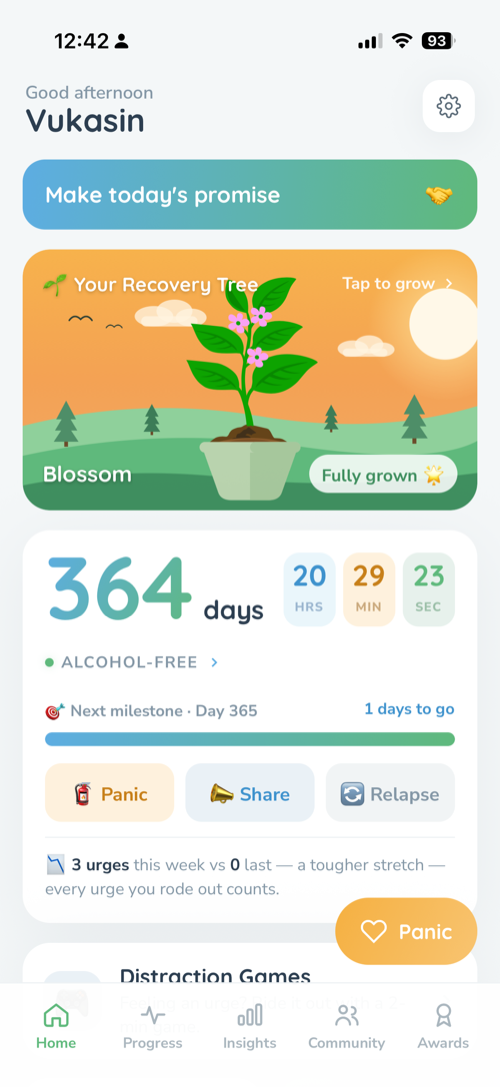
SoberLine is built for exactly this kind of quit: the four functions of a program, on your phone, without a single meeting.
A 30-day recovery path: structure without meetings
Daily Promise: accountability to yourself, every morning
An anonymous community when you want people who get it
Panic button and urge log for the hard minutes
Frequently asked questions
Yes. AA helps many people, but it has never been the only route out of problem drinking. People get sober through SMART Recovery, therapy, medication prescribed by a doctor, online communities, and structured self-directed plans. What matters is replacing what AA provides (accountability, community, ritual and a plan) with pieces you'll actually use.
The main alternatives are SMART Recovery (secular, CBT-based mutual-support meetings), one-on-one therapy using approaches like CBT or motivational interviewing, medication options discussed with a doctor, anonymous online communities, and a structured self-directed plan with daily tracking. Many people combine two or three of these rather than picking just one.
No, but you do need what a sponsor provides: a human being who knows what you're doing and notices how it's going. That function can be filled by a trusted friend you check in with, a therapist, or a daily check-in system you never skip. Accountability is the requirement; a sponsor is one way of getting it.
A pattern of failed solo attempts is information, not a verdict on your willpower. It means the support level needs to go up: talk to a doctor, book a therapist, join a community, or try a meeting anyway, which costs nothing and commits you to nothing. Escalating support is how change works, and there's zero shame in it.
Yes, as long as the maintenance is deliberate. A weekly meeting does four jobs for years: someone who notices if you stop showing up, a fixed commitment, somewhere to put the thinking, and rehearsal for the predictable hard dates. Each one needs a replacement. The usual failure isn't the lack of a program, it's drifting from "without AA" to "without anyone". What holds after the first month covers the specifics.