🌊
Cravings
How long do alcohol cravings last?
The urge wave, explained, and what to do for the minutes it takes to pass.
The short answer to how to stop drinking: you change your environment and your hours, not by gritting your teeth. Check it's medically safe to stop, make alcohol harder to reach, line up support, learn to ride out cravings (each one passes in about 3-10 minutes), commit to one day at a time, fill the hours you used to drink, and treat any slip as data. Structure beats willpower, every time.
Most advice about quitting drinking quietly assumes you'll out-muscle a habit your brain has spent years automating. That's why it fails. Drinking isn't a character flaw. It's a loop: a trigger (stress, boredom, 6 p.m.), a routine (pour a drink), and a reward (relief, for a while). You don't break a loop by being stronger than it. You break it by redesigning the situations it lives in.
Here is a plan that treats you like an adult and doesn't require you to be a hero at 9 p.m. on a Friday.
First, the non-negotiable: if you drink daily, drink heavily, or have ever had withdrawal symptoms (shaking, sweating, racing heart, anxiety spikes when you stop), see a doctor before quitting. Medically supervised tapering exists precisely because sudden withdrawal can be dangerous for dependent drinkers.
Then take an honest inventory, in writing. Not to shame yourself, but to establish a baseline you'll get to watch improve:
Willpower is a terrible gatekeeper but a decent backup. Your primary defense is distance:
Decide now, while you're calm, who you'll contact when a craving hits. That might be a partner, a friend who gets it, or an anonymous community of people doing the same thing. The point is to remove the decision from the hard moment. At 9 p.m. with a craving crawling up your neck, "who could I even talk to?" is one decision too many.
If AA isn't for you, that's fine — it is one of several established groups, and they run on genuinely different principles. Plenty of people quit without any of them. What you can't skip is having some human on your side who knows what you're doing.
Here's the single most useful fact in this guide: an individual craving typically builds, crests and passes within about 3 to 10 minutes. It feels endless because you're inside it, but it's a wave, not a tide. (The full science of craving duration is here.)
So you don't need to defeat the craving. You need to outlast it, and there are three reliable ways:
For a full toolkit for the hard minutes, see how to stop alcohol cravings in the moment.
"Never drinking again" is a sentence your brain refuses to sign. "Not today" is one it can live with. People who stay stopped tend to commit to today only, every day, and then keep receipts:
The proof matters because motivation is unreliable. On a day when you feel like none of it's working, the data disagrees with you, and the data is right. (What to actually record, beyond the day count.)
Quitting leaves a hole in your schedule exactly where the hardest hours live. If you don't fill the 6-to-10 p.m. window with something, cravings will apply for the vacancy. This is less about grand new hobbies and more about small, repeatable rituals: a proper dinner you actually look forward to, a walk, a show, a workout, an earlier night. In the first month, "boring but full" beats "exciting but empty" every time. Part of that is literal: something has to go in the glass, and the evening needs a default so it is not re-decided nightly — which is most of what makes it hold past month one.
If you drink, the drink is information: what was the trigger, what was missing from the plan, what needs to change? Write it down, adjust, and restart the same day, not Monday. The people who make it aren't the ones who never slip; they're the ones whose restart time keeps shrinking. A streak resets. Progress doesn't. (What to do in the hours right after one.)
These seven steps are built for getting stopped. Staying stopped is a different problem with different equipment, and the handover happens somewhere around week five — usually without warning. Four things tend to come up once the plan above is working:
And if the plan fails somewhere along the way, that is not a reason to throw out the plan. Step 7 says treat a relapse as data; the practical version of that, in the hours when it is hardest to be reasonable, is here. The people who make it are not the ones who never slip. They are the ones who patch one specific hole each time and carry on.
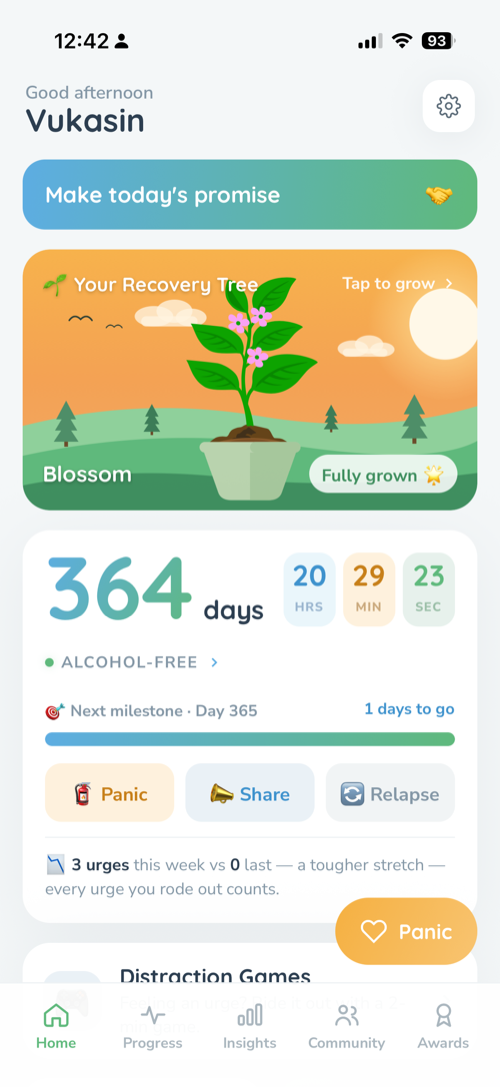
SoberLine is this plan, built into an iOS app. It's the structure so you don't have to be the structure (and if you'd rather weigh it against the alternatives first, we wrote an honest comparison of the sobriety apps, plus closer looks at Nomo and I Am Sober):

This plan is the spine; each step has a guide of its own going deeper. The full guide index is here, including the tools, sleep, money and support-group pages that sit under these seven steps.
The urge wave, explained, and what to do for the minutes it takes to pass.
From the first 24 hours to a full year: what your body repairs, and when.
Use the free calculator to see your monthly and yearly number.
Free to try. You're not alone in this.