🌱
The full plan
How to stop drinking: a realistic 7-step plan
Structure beats willpower: the complete guide.
How much money do you save not drinking? It's arithmetic, not a statistic, and the arithmetic is bigger than most people guess. As an illustration: at 10 drinks a week averaging $8 each, that's about $80 a week (roughly $350 a month, or around $4,100 a year) before you count rideshares, late-night food and the hangover days. Most people who finally add it all up find they'd been underestimating by about half. Run your own numbers below.
One honest tip before you adjust the sliders: use a normal week, not your best week. The calculator can only be as truthful as the inputs, and the whole point of this page is that the truthful number is the useful one.
Ask someone what they spend on drinking and their brain does the reasonable-seeming thing: it counts the drinks. A few beers on Friday, wine with dinner twice a week, a cocktail or two on Saturday. That mental tally feels rigorous. It's also usually about half the real figure, because drinking rarely travels alone. Around every drink is an orbit of spending that never gets filed under "alcohol":
None of this is a verdict on how you spend money. The money is a mirror, not a judgment: it simply shows you the size of the habit in a unit that doesn't negotiate. Drinking spend is easy to miss precisely because it's designed to be: small amounts, high frequency, blended into social life. Adding it up isn't about guilt. It's about finally seeing the whole shape of the thing you're changing.
It also means the math moves even if quitting entirely isn't your plan. Halve the drinks and you tend to halve the orbit too: the rides, the late food, the extra rounds. If moderation is your goal, start with how to cut back on drinking without quitting completely.
Weekly numbers are easy to shrug at. Eighty or ninety dollars a week sounds like a nice dinner: forgettable. The same money viewed across a year is a different object entirely. Take the calculator's default illustration: $95 a week, once the extras are counted, is nearly $5,000 a year. That's not dinner money. That's:
There's a second kind of compounding here, too. Money is only one of the two timelines that start the day you stop: while your account rebuilds, your body runs its own recovery schedule in parallel: sleep first, then mood, skin, blood pressure, liver. The two reinforce each other, and both reward the same behavior. You can see the health side laid out week by week in what happens when you stop drinking: a timeline.
The drink itself is the smallest line. The financial benefits of quitting alcohol that people notice within a few months are the ones attached to it: the taxi home instead of the walk, the delivery order at 11 p.m., the write-off Saturday that turns into a spending day, the impulse buys made at 1 a.m. Add the slower ones — fewer sick days, lower dental and insurance costs, a gym membership that finally gets used — and the honest total is usually well above what the receipts alone show. Worth logging alongside the day count, which is the case for tracking more than one thing.
Ask people a year into sobriety what happened to the money, and the answers cluster in a telling way. Many report finally clearing a credit card or a lingering debt. Some book the trip they'd been deferring, often as a deliberate reward for a milestone. A lot of it goes into upgrading ordinary life: a gym membership, better groceries, proper coffee gear, the hobby that now fills the hours drinking used to occupy. And some people, interestingly, do nothing with it at all on purpose: they let the balance sit and grow, because watching it climb has become part of the motivation itself.
Notice the pattern: almost nobody reports spending it on anything as fleeting as what it replaced. When the money becomes visible, people instinctively point it at things that last.
Here's the part most savings advice skips. Money you don't move is money you don't notice. Leave your former drinking spend in your everyday account and it evaporates into groceries, subscriptions and small conveniences within a month. You'll be saving it and it will feel like nothing is happening. Two small moves fix that:
The deeper reason this works is that a visible, growing number changes what not-drinking feels like. On a hard evening, an abstract commitment competes badly with a concrete craving. A total that reads $1,284 (and will read more tomorrow) competes just fine. It reframes every skipped drink from deprivation into earning, which is exactly the mental flip that makes the whole thing sustainable. It's one of the most underrated tools in the kit, right alongside the structural changes in how to stop drinking: a realistic 7-step plan.
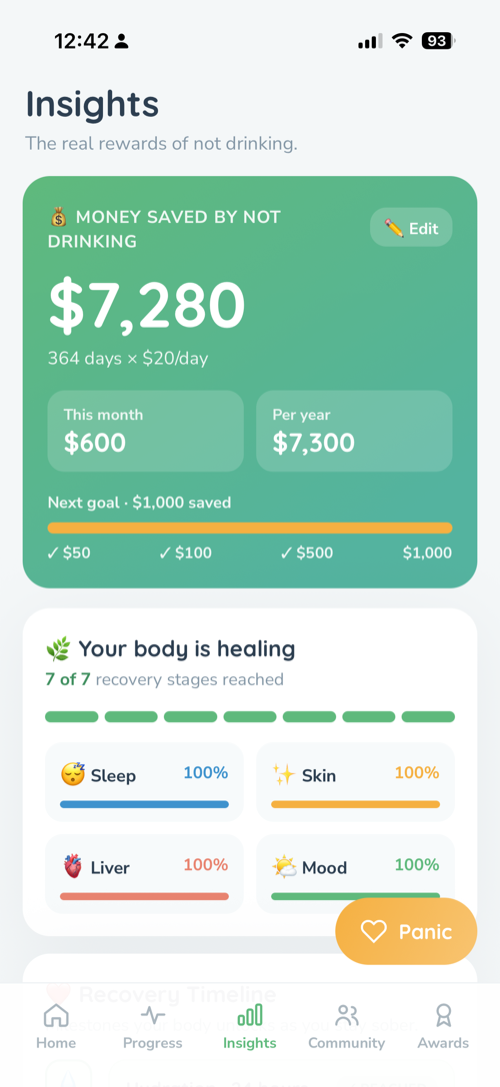
SoberLine makes the number impossible to forget. Enter your former weekly spend once, and the app keeps it in front of you:

Structure beats willpower: the complete guide.
From the first 24 hours to a full year: what your body repairs, and when.
Clear rules, honest tracking, fewer drinks: moderation that actually holds.
Free to try. You're not alone in this.