🌱
The full plan
How to stop drinking: a realistic 7-step plan
Structure beats willpower: the complete guide.
What happens when you stop drinking follows a rough timeline, and repair starts sooner than most people expect. For many, sleep begins to improve within the first several days, and the first weeks bring steadier mood, calmer digestion and brighter skin. Over the following months, blood pressure often improves, the liver gets a real chance to repair itself, and energy becomes more even and reliable. By one year, those changes have compounded into something you can feel every single day.
One of the strangest things about stopping drinking is that the best parts are invisible at first. Your body starts repairing itself almost immediately, but quietly, in the background, on its own schedule. Knowing that schedule matters, because the early days are the hardest ones, and it helps to know exactly what you're buying with them. Here's the arc, from the first 24 hours to a full year.
Before the timeline: for most lighter drinkers, stopping is uncomfortable but safe. If you've been drinking heavily or daily, though, your body may have adapted to alcohol, and stopping suddenly can cause withdrawal, which in some cases is a medical emergency. This isn't a willpower question; it's a physiology one, and it deserves a professional's eyes.
This guide won't tell you how to detox or taper. That's between you and a doctor. What it will tell you is what the road ahead can look like once you're safely on it. If you're still working out your approach, start with a realistic plan for stopping, then come back to the map below.
Within hours of your last drink, your body gets to work. Alcohol is treated as a priority toxin, so your liver clears it first, usually within the first day, depending on how much was in your system. As it leaves, your blood sugar and hydration start to stabilize, which is why the classic first-day feeling is a strange mix: tired, foggy, maybe headachy, but with a faint sense of the dust settling.
Emotionally, day one often feels bigger than it looks from outside. There can be restlessness, irritability, and a loud awareness of the habit you're interrupting, especially at your usual drinking time. That's normal. Nothing is wrong; your brain is just noticing that the routine changed. Keep the first evening simple, hydrate, eat real food, and let the day be unremarkable. Unremarkable is a win.
Here's the counterintuitive part: the first two or three nights without alcohol can feel worse, not better. Alcohol sedates you into sleep but then fragments the second half of the night, and when it's gone your sleep architecture has to recalibrate. Many people get lighter sleep and unusually vivid dreams for a few nights.
Then, often somewhere around night three to seven, the turn comes. Without alcohol suppressing it, deep sleep and REM sleep can start returning to their natural rhythm. For many people this is the first repair they can actually feel: waking up before the alarm, or at least waking up without the 3 a.m. jolt. Sleep keeps improving for weeks after this point, and better sleep quietly makes everything else on this timeline easier, including cravings, which are strongly fueled by tiredness.
By the end of the first week, hydration has usually normalized, and with it often comes less puffiness in the face and hands. Digestion tends to calm down as the stomach lining gets a break from alcohol's irritation. Many people notice their skin looking a little brighter: partly hydration, partly better sleep.
Mood is the bigger story. Alcohol gives with one hand and takes with the other: it soothes an evening but often amplifies the next day's anxiety. Two weeks in, that next-day static begins to fade for many people, and mood starts becoming steadier: not euphoric, just quieter. This is also the stretch where cravings are usually at their most frequent, which is worth knowing in advance: they fade on this same schedule, strongest in the first two weeks and noticeably lighter after. We've mapped that curve in detail in how long alcohol cravings last.
A month is where the inside changes start showing on the outside. For many people, four alcohol-free weeks can mean clearer skin, less bloating, and (if drinking was adding a meaningful number of empty calories) the beginning of gradual weight change. Energy in the mornings tends to be noticeably better than it was on day three.
Under the surface, a month of rest can matter enormously to your liver: for many people, the early buildup of fat in the liver can begin to reduce within weeks of stopping. Blood pressure may also start trending in the right direction for some. None of this is guaranteed or uniform (bodies differ, histories differ), but a month is genuinely long enough for measurable repair to be underway. It's also long enough for the other timeline to get interesting: the money you're not spending has been quietly stacking up in parallel, and the savings math at 30 days tends to surprise people.
Around the three-month mark, the changes stop feeling like recovery and start feeling like a baseline. Energy is typically more even across the whole day rather than arriving in spikes and crashes. Sleep is usually deep and boring: the good kind of boring. For many people, blood pressure and resting heart rate continue to improve, and routine blood work often starts reflecting the change, which is a satisfying thing to see in writing.
Psychologically, three months is where identity begins to shift. You've now handled birthdays, bad days and Friday nights without drinking. Cravings, when they come, are occasional visitors rather than a nightly siege. The habit loops that once ran on autopilot have been rewritten dozens of times over.
Half a year in, most of the early repairs have matured. The liver, if it wasn't severely damaged to begin with, has had six months of uninterrupted repair time, and for many people its function is substantially improved. Immune function can benefit too; some people find they simply get sick less often than they used to.
Just as important: your habits have been fully rebuilt around the person you are now. Evenings have new shapes. Stress has new outlets. Six months is also a milestone worth marking deliberately: in SoberLine, it's the moment your Recovery Tree reaches full bloom, which feels about right.
A year without alcohol isn't one benefit; it's every earlier benefit, compounded. Twelve months of real sleep. Twelve months of steadier mood and lower baseline anxiety for many. A liver that has had a full year to repair. Blood pressure, weight and heart health that have had four full seasons to move in the right direction. Research on long-term abstinence also suggests that stopping drinking can reduce several long-term health risks over time, the kind of benefit you never feel on any single day but that quietly changes the odds.
And beyond the body: a year of un-drunk money, a year of remembered evenings, a year of proof. People rarely describe year one as easy. They very often describe it as the best trade they've made.
One last thing about this whole timeline: it isn't a test you can fail. If you slip on day 40, the repairs from days 1-39 weren't erased, and the road back is shorter than the road in. The timeline restarts; the learning doesn't.
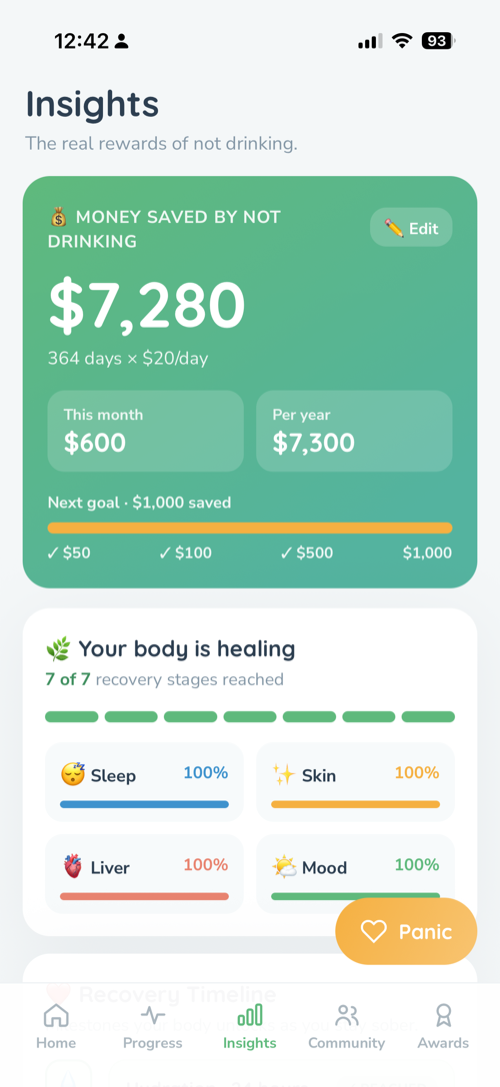
The hardest part of this timeline is that you can't feel most of it happening. SoberLine makes the invisible repairs visible:

Structure beats willpower: the complete guide.
The other timeline: watch the total climb alongside your streak.
Free to try. You're not alone in this.