🌱
The full plan
How to stop drinking: a realistic 7-step plan
Structure beats willpower: the complete guide.
How long do alcohol cravings last? A single one typically builds, crests and passes in about 3-10 minutes, occasionally 20-30 for an intense one. Over weeks, cravings also get weaker and rarer: strongest in the first two weeks, noticeably lighter by day 30, occasional after a few months. You don't have to defeat a craving. You have to outlast it. And it's shorter than it feels.
When a craving hits, the most convincing lie it tells is about time: this will last all night, so you might as well give in. The science says otherwise. Understanding what a craving actually is, and how quickly it collapses on its own, turns an overwhelming wall into a wave you can ride.
A craving isn't your body demanding alcohol. It's your brain making a prediction. After years of learning "trigger → drink → relief," a trigger (stress, a time of day, walking past the old bar) fires a surge of anticipation: dopamine-driven wanting that grabs your attention and marks the thought URGENT.
But predictions have a shape. Researchers who study urges describe a consistent curve: the craving builds over a minute or two, crests (the peak intensity, usually brief) and then, if it isn't fed, recedes. The whole wave typically completes in 3-10 minutes. What keeps a craving alive longer isn't the trigger; it's the argument you have with it. Ruminating, bargaining, and "just deciding" over and over re-triggers the wave.
This is the basis of urge surfing, a technique from relapse-prevention therapy: instead of fighting the wave or obeying it, you observe it: notice where it sits in your body, breathe, and let it complete its arc. The craving passes either way. The only question is whether you drank during it.
The second timescale matters just as much as the minutes:
Every craving you ride out actually speeds this timeline up. Each unfed wave weakens the "trigger → drink → relief" prediction, a process called extinction. You're not just surviving cravings; you're retraining the machine that makes them. For the full picture of what else your body repairs on this schedule, see what happens when you stop drinking, week by week.
Don't try to feel differently. Do something differently. Three moves reliably shorten the subjective length of a wave:
And if the craving is a nightly 9 p.m. regular? That's not a craving problem, it's a schedule problem. The fix is upstream, in how you structure the drinking hours. For a deeper toolkit, including what to do when a craving catches you in public, read how to stop alcohol cravings in the moment.
Here is what that looks like on an actual evening, because the list above reads tidier than the minutes feel. Say it's a Thursday, 8:40 p.m., and the urge arrives while you're clearing up after dinner. Minute one: you notice it, and the first thought is the usual one, that this will go on all night. Minute two: you sit down and breathe in for four, hold for four, out for four, and the peak is unpleasant but not worse than it was. Minute four: you open something that needs your full attention, a puzzle or a game that punishes distraction, and for a stretch you forget to check whether the craving is still there. Minute seven: you check. It's smaller. Minute ten: you're mildly annoyed at the dishes and no longer thinking about a drink at all. Nothing heroic happened. You did three ordinary things in a row and the wave finished its arc without you.
The version that goes wrong runs differently. Minute one, same thought. Minute two, you start arguing with it: maybe just one, no, but it's been a hard week, no. Minute six, still arguing. Minute fifteen, you're worn down and the argument has been going on longer than the craving ever would have. That's the part worth noticing: the craving didn't last fifteen minutes. The argument did.
This is the question people actually mean when they search for how long cravings last, and the honest answer has three parts, because "stop" means three different things.
How often they come. This drops fastest. In the first fortnight they can arrive several times a day, tied to every old cue. By the end of the first month most people notice long stretches with none. By month three they're occasional rather than a daily feature.
How strong they are. This drops too, though less evenly. An early craving can feel like a physical demand. A later one is more of a passing thought with a bit of pull behind it, the sort you can decline without much effort. The wave still has the same shape, it just doesn't get as high.
Whether they ever go away for good. Here it's better to be straight with you. Trigger cravings, the kind set off by a particular bar, a funeral, a very good or very bad day, can turn up years later. They're rare, they're weak, and they pass quickly, but the honest word is "rare", not "never". People who expect that are fine when it happens. People who were promised "gone by day 90" sometimes read a year-two craving as proof they failed, and that reading is more dangerous than the craving.
So: the constant, ambient version stops within a few months for most people. The occasional trigger version becomes something you handle rather than something you fear. That's what "stop completely" realistically looks like.
Mostly, no. The build, crest and fade pattern is the same whether the urge is for a drink, a cigarette, a phone, or the fridge at midnight. Urge surfing was developed for exactly that reason: it works on the shape of the wave, not on what the wave is about. If you've ever waited out a craving for something else and watched it pass, you already have the skill.
Where alcohol differs is in the cues. Drinking is woven into more of an ordinary week than most habits: the end of the working day, food, weekends, other people, celebrations, grief. So the waves come from more directions and, early on, more often. It's not that each one is harder to ride. There are just more of them, until the cues fade. And unlike most urges, an alcohol craving in someone who has been drinking heavily and daily can sit alongside actual withdrawal, which is a medical matter rather than a willpower one. That's what the note below is about.
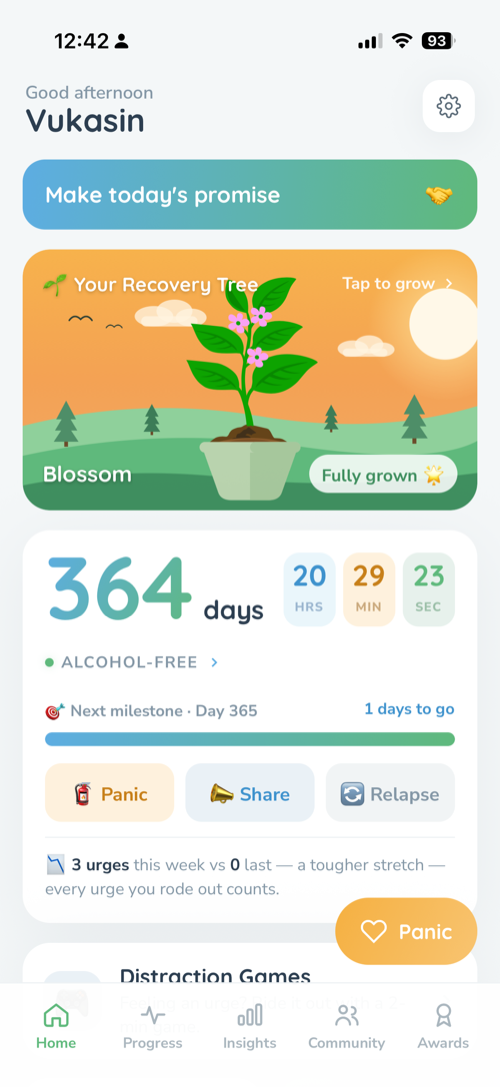
SoberLine's Panic Button is built for exactly these minutes. One tap, and the wave has something to crash against:

Structure beats willpower: the complete guide.
Seven tools for the hard minutes: at home, at work, or out with friends.
From the first 24 hours to a full year: what your body repairs, and when.
Free to try. You're not alone in this.