🌱
The full plan
How to stop drinking: a realistic 7-step plan
Structure beats willpower. The complete guide.
How to stop alcohol cravings, in short: you don't beat one, you outlast it. Seven tools, roughly in the order to reach for them:
A craving in full flood doesn't feel like a thought. It feels like a command. But it has one weakness you can exploit every single time: it's on a timer. A single urge builds, crests and passes in minutes, and the full science of that wave is in how long alcohol cravings last. This page is the other half: not what a craving is, but exactly what to do while one is happening. Seven tools. You won't need all of them every time. Most waves break against the first two or three.
The craving's core sales pitch is now. So your first move is simply to refuse the deadline. Say it to yourself in these words: "I can still decide to drink in twenty minutes. First I'm going to do one thing from the list." You're not white-knuckling a forever-decision. You're making a twenty-minute one, and twenty minutes is longer than most waves survive.
Set an actual timer. It sounds trivial; it isn't. A timer converts an open-ended battle into a defined window, and defined windows are winnable. When it rings, most people find the urge has already lost its teeth.
A craving isn't just a thought. It's arousal: tight chest, restless hands, urgency. You can't argue your body out of that state, but you can breathe it out. Here's the exact drill:
Don't aim to feel calm. Aim to finish the rounds. The calm is a side effect, and it usually shows up around round six.
Urge surfing comes from relapse-prevention therapy, and it flips the whole frame: instead of fighting the craving or obeying it, you observe it. Four steps:
The first few times it feels strange, like meditating in a burning building. Stay with it. With repetition it becomes the single most reliable tool on this page, because it works anywhere, silently, with no equipment.
A craving lives in your attention, so the move is to rent that space to something else. The key word is hard: the distraction has to be demanding enough that you physically can't ruminate at the same time. Scrolling doesn't qualify. Background TV doesn't qualify. These do:
The test is simple: if you can still hear the craving narrating in the background, the distraction isn't hard enough. Ten minutes of genuinely absorbed attention outlasts most waves.
Cravings are context machines. The room, the chair, the hour, the glass cabinet in your peripheral vision: they're all part of the trigger. So break the set: stand up, put shoes on, walk around the block, move to a different room, turn the lights up. Movement plus new sensory input often snaps a wave mid-crest, because half of what was feeding it just disappeared from view.
A surprising number of "alcohol cravings" are partly hunger, low blood sugar or plain thirst wearing a costume. Eat something with actual substance, and pour yourself a replacement drink: sparkling water with a dash of bitters, a non-alcoholic beer, a proper tea made slowly. The hand-and-ritual part matters as much as the liquid: a cold glass, something interesting in it, the act of sitting down with a drink. That ritual is a big share of what the craving was actually asking for.
Do the logistics in advance: keep your replacement stocked, and pour it before your usual craving hour, not during it.
Cravings do their best work in secret, where they can whisper without contradiction. Saying "I'm having a craving right now" (out loud or by text) cuts their power fast, sometimes instantly. You're not asking anyone to fix anything. The message itself is the tool. Send it to a friend, a partner, a sponsor, anyone safe.
While you wait for the reply, play the tape forward. The craving is selling you a movie trailer: the first drink, the first ten minutes of relief. Play the whole film instead: the third drink, the fourth, the broken sleep, the 7 a.m. version of you resetting a counter and rebuilding the day. Cravings only ever advertise the opening scene. You've seen the ending.
At home, 9 p.m. This is conditioned time: your brain fires the anticipation at the old hour whether you plan to drink or not. Get ahead of it: pour the replacement drink at 8:45, before the wave, and restructure the hour itself: shower, walk, game, call. If the trigger is the couch-plus-phone-plus-9-p.m. combination, breaking any one of the three is often enough.
At work. The craving that starts at your desk after a brutal meeting is usually earmarked for later: it's planning tonight's drink at 3 p.m. Intercept it early: two minutes of 4-4-4 in a stairwell or bathroom stall, a text to your person, and a concrete decision about what you'll drink tonight before you leave the building. An urge with no open slot in the evening has nowhere to land.
At a party or restaurant. Order a non-alcoholic drink first thing, before anyone asks: a glass in your hand answers the question before it's raised and keeps your hands busy. The script is five words: "Soda with lime, please." If someone pushes, "I'm not drinking tonight" is a complete sentence; you never owe an explanation. And have an exit plan: your own ride, and permission to leave by ten if the room gets loud in the wrong way.
Everything above is defense for the minutes. This section is offense for the weeks:
Each wave you ride out also weakens the loop that generates them: the "trigger, drink, relief" prediction fades when it stops being paid. If you want the structure around all of this, the routines and the plan for the drinking hours, that's the job of the full 7-step guide to stopping drinking. And if cravings are winning every time right now, if you keep drinking despite genuinely wanting not to, that's not a willpower defect, and there's a page written for exactly that moment: "I can't stop drinking": what to do right now.
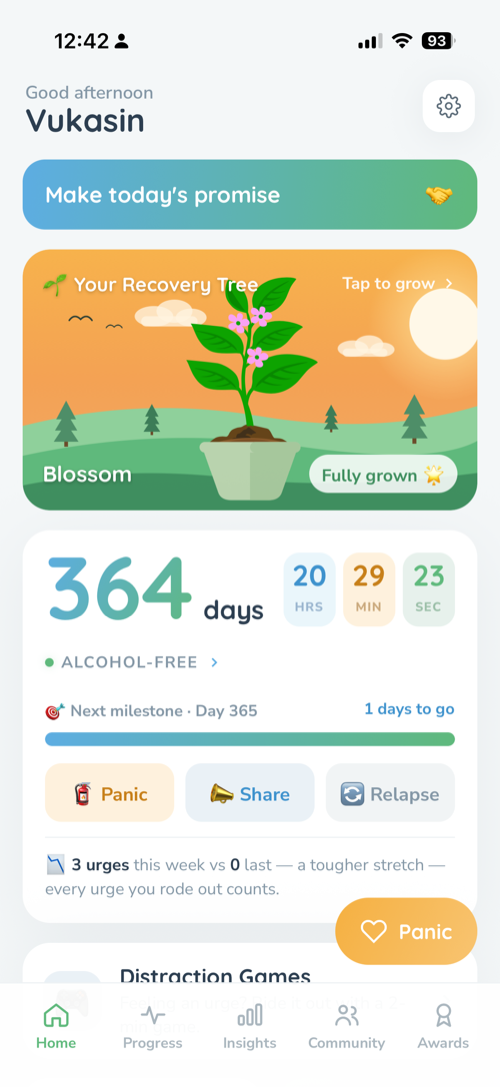
When the wave hits, SoberLine puts this whole toolkit one tap away:

Structure beats willpower. The complete guide.
The science of the urge wave, and why it's shorter than it feels.
If cravings are winning every time, start here. No shame, just next steps.
Free to try. You're not alone in this.