🔁
Setbacks
What to do after a relapse: tonight and tomorrow
The damage from most slips is not the alcohol. It is the four days after it.
How to stay sober is a different problem from how to stop: stopping runs on crisis energy, staying runs on maintenance once the crisis has gone. Month two is the predictable risk point, because feeling better quietly weakens the reason you stopped. What holds: a default activity in the old drinking slot, protected sleep, a plan made in advance for the four foreseeable hard occasions, one person who notices, and evidence you can check on a flat day.
Advice on how to stay sober is usually advice on how to get sober, repeated. They are not the same problem. Stopping is a decision made under pressure, and it has adrenaline behind it. Staying is a maintenance problem, made in the absence of pressure, once the crisis energy has gone and nothing dramatic is happening. That is a different job, and it needs different equipment. SoberLine is built for the second one.
The first few weeks have their own momentum. Cravings are frequent but so is the sense of doing something significant, and progress is fast enough to feel.
Then it flattens. Sleep is better, the mornings are better, and the reason you stopped starts to feel less urgent precisely because it worked. Nothing is wrong. That is the risk: there is no longer a crisis arguing your case, and "one won't hurt" is a much better argument at week eight than it was at week one. Almost nobody plans for this, and it is the single most predictable moment in the whole thing.
Most drinking is a scheduled event pretending to be a spontaneous choice. If the 7 p.m. slot is still empty at week six, you are relying on willpower to fill it every single night, and willpower is a depleting resource — which is exactly why it fails on the days you are tired. Give the slot a default: a walk, a specific drink, cooking properly, a class with other people in it. It does not have to be virtuous. It has to be automatic. What goes in the glass is a real part of this — we cover the replacement ritual separately.
Tiredness is rocket fuel for urges, and it is the variable people discount hardest. A fixed wake time does more for staying sober than most of the advice written about staying sober. If sleep is the thing that broke, treat that as the priority rather than a side issue.
They are not mysterious: a bad day at work, a wedding or a party, a holiday, and an anniversary or bereavement. Each of these is foreseeable weeks out. Decide in advance — what you will drink, how long you will stay, who you will tell, and how you get home. A decision made on Tuesday is worth ten made at the event. For parties and nights out specifically, see staying sober when your friends are drinking.
Not necessarily a group, though groups do this well. One person who knows what you are doing and will ask about it is the difference between a quiet fortnight and a quiet fortnight nobody notices. Isolation is the common thread in most slips.
Cravings do not stop entirely; they get rarer and weaker, and they still show up after a rough day years later. What changes is that you have a rehearsed response instead of an argument with yourself. The in-the-moment toolkit is the same at month twelve as at day three.
On a flat Wednesday your memory of why you stopped is unreliable and unhelpfully vague. A written record — money saved, what improved, how many urges you have already outlasted — is the only thing that reliably beats "was it even that bad?". This is the whole argument for tracking more than the day count.
We are not going to publish a wall of testimonials — we have no consenting users to profile and inventing them would be worthless to you. What we can say honestly is what the common threads look like in the accounts people do publish, and in relapse-prevention research generally:
Yes, unevenly. The daily effort drops a lot in the first few months as the evening routine stops needing to be decided. What does not disappear is the occasional out-of-nowhere urge attached to a specific trigger. It arrives less often, passes faster, and by then you have done it enough times to know it will. Sobriety stops being the main thing you are doing and becomes a fact about your week — which is the actual goal, and worth naming, because "one day at a time" forever is a bleak thing to be promised. It gets easier. It just does not get finished.
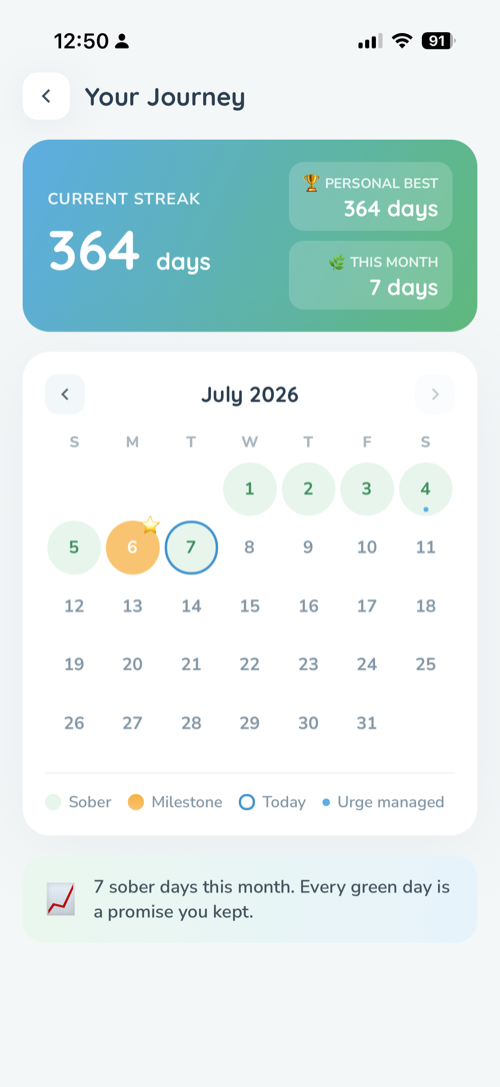
Most of this list is maintenance, which is exactly what an app is good at holding:

The damage from most slips is not the alcohol. It is the four days after it.
Days are the easy part. What else is worth writing down, and why.
Structure beats willpower: the complete guide.
Free to download, with a free trial for new members. You're not alone in this.