🌱
Staying sober
How to stay sober: what actually holds after the first month
Month two is the predictable risk point, and almost nobody plans for it.
How to stay sober when your friends are drinking comes down to deciding before you walk in. Know what you'll drink, how long you'll stay, who there knows, and how you get home. Get a soft drink in your hand early, keep your answer to "want a drink?" short and the same every time, and leave when the night turns loud and repetitive. The first few nights out are the hardest. After that it's mostly routine.
Working out how to stay sober when your friends are drinking is a different job from getting through a quiet Tuesday at home. At home the drink is something you'd have to go and get. At a party, a birthday or the usual Friday round, it comes to you, over and over, usually from people who like you and mean well. None of the tips below need anyone else to change. They just stop the night from being decided for you. If you're earlier in this and still working out how to stop at all, start there and come back.
Almost every slip at a social event happens to someone who arrived without a plan and tried to make one in the room, three conversations in, with a drink being held out. So make the decisions on the way there, when nobody is asking.
The most pressure you'll get all night comes right at the start, when the host or whoever's at the bar asks what you're having. Walk in, say hello, and get your drink into your hand before anyone else can choose one for you. A glass in your hand ends most offers before they start. People top up empty hands. They don't usually look at what's in a full one.
If it's a round at the pub, offer to get the first one. You order yours, they get theirs, and the question of what you're "having" never comes up in front of the group.
You don't owe anyone an explanation, and the longer the explanation, the more it invites a debate. Pick one short line and use it every time:
The first offer is easy. The second one is the one that matters. That's where most people start explaining, and explaining sounds like an opening for negotiation. Say the same line again, same tone, and change the subject. By the third time most people stop asking.
"I don't drink" is worth getting comfortable with, even if it feels too big at first. "I'm not drinking at the moment" invites the question of when you will again. "I don't drink" is a closed answer, and it gets easier the more often you say it.
You don't need to make an announcement to the group. You need one ally. A friend who knows can hand you a soft drink without making it a thing, skip you on the round, change the subject when someone leans on you, and notice if you've gone quiet. Text them before you arrive. It takes thirty seconds and changes the whole night.
What you tell them is up to you. "I'm taking a break" is enough. So is "I'm trying a month off". You can tell the fuller story later, or never.
Most friends accept a no the first time. Some don't. The pressure usually sounds like a joke ("one won't kill you", "you're no fun anymore"), and it's usually more about them than you. Your not drinking can make someone a little uneasy about their own glass, and teasing is how that comes out.
You don't have to win that conversation. Say your line once more, then move. Go to the bathroom, go talk to someone else, step outside. If one person keeps at it all night, that's information about the evening, and leaving is a completely fine response to it.
There's a point in most nights out, usually around two hours in, when conversations start to loop, the music gets louder and everyone else is a few drinks ahead. That's your cue. Nothing good for you happens after it, and it's also when the "just have one" offers get more persistent and less thoughtful.
Leaving early is not a failure. It's the plan working. Say a proper goodbye to the host, skip the round of farewells, and go. You'll be the only person at that party who wakes up tomorrow feeling completely fine, and that's a good thing to notice.
It might. The smell, the clink of glasses, the old ritual happening right in front of you. That's normal, and it doesn't mean the night is lost. A craving peaks and passes, usually within 10 to 20 minutes, if you don't feed it.
If it doesn't settle, that's your reason to leave. The full craving toolkit goes into more depth, and how long a craving actually lasts is worth knowing before the night you need it.
This one is harder, and it's worth being honest about. If most of what you do with a group is drink together, stopping changes the friendship, at least for a while. Suggest the same people at a different time: breakfast, a walk, a match, a gig, a film. The ones who say yes are your friends. The ones who only ever show up at the pub might have been more of a shared habit, and that tends to become clear in the first month or two.
That can feel lonely. It's also usually temporary. Most people find their social life rebuilds within a few months, and some of it ends up better than before. If you want people who already get it, groups and communities are a good place to find them.
The first sober party feels strange. You notice everything: how often people refill, how loud it gets, how much of the conversation is about the drinking itself. By the third or fourth event it feels much less like a test. You have your drink, your line, your leaving time, and it all runs without much thought. That's the point where social events stop being a risk and become just something you do. If the evenings at home are the harder part for you, staying sober past the first month covers the rest.
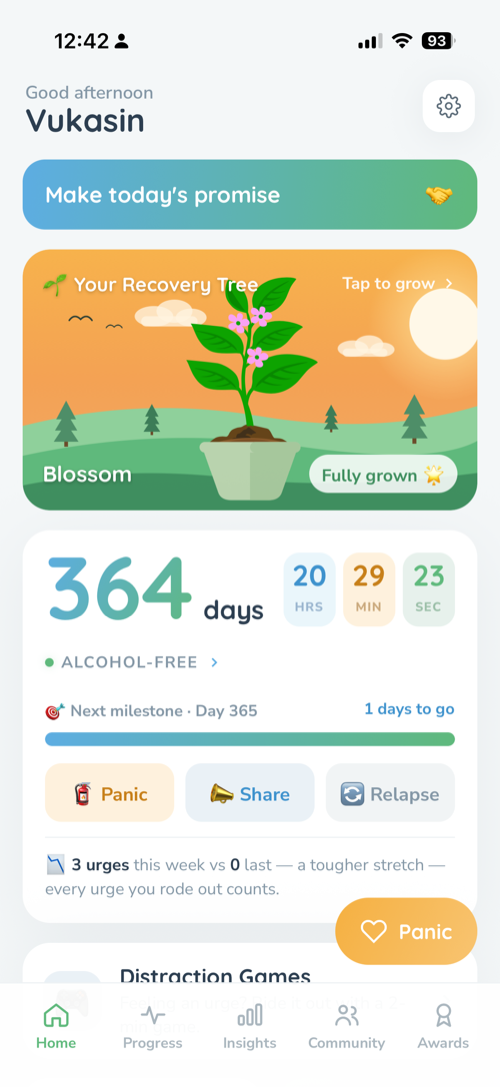
Most of this happens in your head, but a few things are easier with your phone in your pocket:

Month two is the predictable risk point, and almost nobody plans for it.
The drink was never only the drink. What to pour, and what else the evening can hold.
Free to try. You're not alone in this.