🧭
Methods
How to quit drinking without AA
You don't have to work the steps. What AA provides, and how to build it yourself.
There are more quit drinking support groups than most people realise, and they run on genuinely different principles: AA (largest, twelve steps, higher power), SMART Recovery (secular, CBT-based), LifeRing (secular, no prescribed method), Moderation Management (for cutting down, not quitting) and large free online communities. Nearly all now meet online. Go three times before you judge one.
Most people looking for quit drinking support groups know exactly one name, and assume the choice is between that and nothing. It is not. There are several well-established groups running on genuinely different principles, most of them meet online now, and picking on principle rather than on default matters more than which one you pick. If you want something in your pocket between meetings, SoberLine has an anonymous community.
Be clear about what you are buying with the hour. Groups provide three things software does not: other people who will notice if you stop showing up, a regular fixed commitment in the week, and the specific relief of hearing your own thinking said out loud by someone else. The US National Institute on Alcohol Abuse and Alcoholism describes mutual-support groups as a valuable added layer of support alongside professional treatment — added, not instead of.
The largest by a wide margin, free, and available almost everywhere in person and online at almost any hour — which on a bad Tuesday night is not a small thing. Twelve steps, sponsorship, abstinence-based, and it uses the language of a higher power, which members interpret very broadly but which is genuinely a barrier for some people. If you want the most meetings and the most people, this is it.
Secular and built on cognitive behavioural principles rather than steps: a four-point programme covering motivation, urges, thoughts and feelings, and building a balanced life. Face-to-face meetings worldwide plus daily online meetings, a message board and a 24/7 chat room. If the higher-power framing is what has kept you out of a room, this is the usual answer.
Also secular, abstinence-based, and deliberately light on programme: no steps, no prescribed method, the emphasis is on each person building their own plan with the group as the sounding board. Smaller than the two above, free, donations welcome. Suits people who want the room but not a method.
The outlier: it does not assume abstinence is the goal. It supports people choosing either moderation or abstinence and taking responsibility for the choice. In-person, video and phone meetings. If you are cutting down rather than quitting, an abstinence-only room will keep telling you that you are in denial, and this one will not.
Abstinence-based, built on mindfulness and Buddhist practice rather than steps or CBT. Smaller network, strong fit for people already drawn to meditation practice.
Not meetings, and worth counting separately. The largest recovery forums have hundreds of thousands of members, run at every hour, and cost nothing — Reddit's stopdrinking community is the best known, where members greet each other with "I will not drink with you today". The trade-off is real: enormous availability and total anonymity, but no one there will notice if you go quiet, and nothing you read is vetted.
Four questions get most people to an answer in about a minute:
Then the part that matters more than the choice: go three times before you judge it. First meetings are uniformly strange, and the strangeness is not information about whether it works. If after three you know it is wrong, try a different group rather than concluding groups are not for you — they are not interchangeable.
Some people will not, and pretending otherwise helps nobody. What matters is that you replace the function rather than skipping it: one person who knows what you are doing and will ask, a fixed weekly commitment that is not negotiable, and somewhere to put the thinking. That is the self-directed route, in detail.
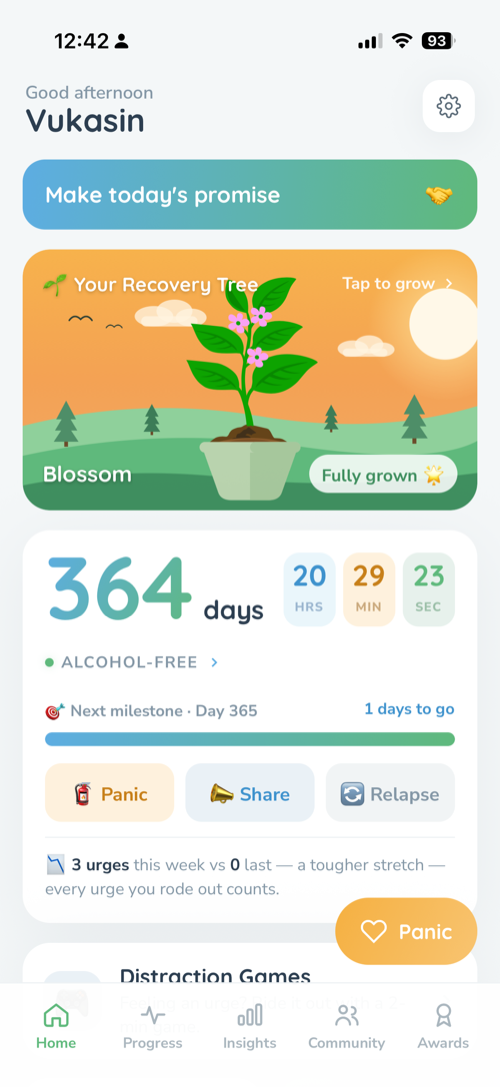
An app is not a group, and we are not going to pretend it is. What it covers is the gap between meetings:

You don't have to work the steps. What AA provides, and how to build it yourself.
If you keep trying to stop and can't, you're not broken. Concrete steps for tonight.
Structure beats willpower: the complete guide.
Free to download, with a free trial for new members. You're not alone in this.