Can't Sleep Without Alcohol? Why, and What Actually Helps
Updated August 2026 · 7 min read · By the SoberLine team
The short answer:
If you can't sleep without alcohol, the reason is mechanical, not personal. Alcohol is a sedative, so it puts you under fast — then rebounds in the second half of the night and suppresses REM. When you stop, your brain is still compensating for a depressant that is no longer arriving, so sleep usually gets worse before better, often for the first week or two, with vivid dreams as REM comes back. For many people sleep is better than it was while drinking by month two.
Read this first: insomnia is a withdrawal symptom. If you drink heavily
or every day, stopping suddenly can be dangerous — seizures and delirium tremens are real
risks and they are medical emergencies. Talk to a doctor before you quit, and if
sleeplessness comes with shaking, sweating, a racing heart, confusion or hallucinations,
get medical help now. In the US, call the SAMHSA
National Helpline at 1-800-662-4357 (free, 24/7), or dial 988 in a crisis.
Nothing below is medical advice.
If you can't sleep without alcohol, you have not developed a personality
trait — you have a nervous system that has been handed a sedative every night for long
enough that it stopped producing the effect on its own. That is reversible, it is the single
most common reason a two-week quit collapses, and knowing the mechanism makes the waiting
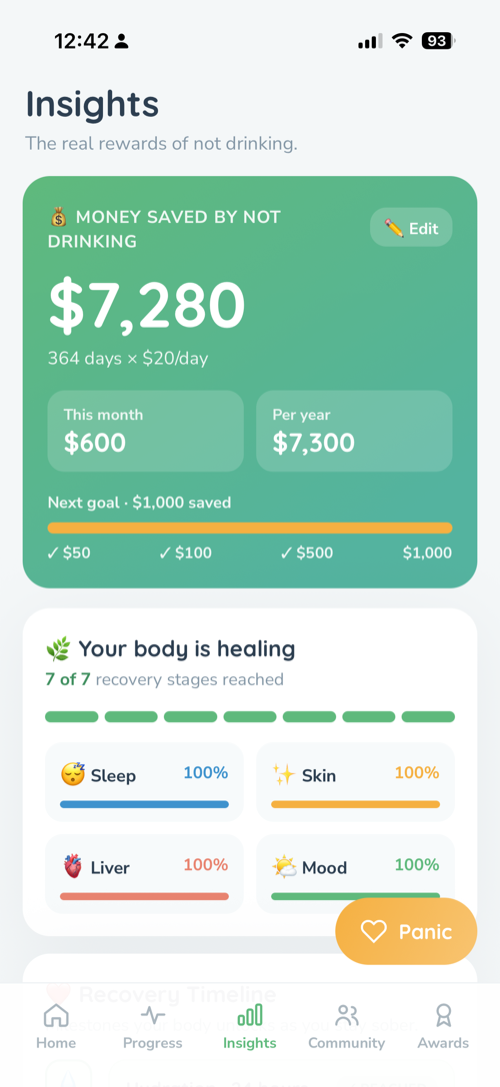
survivable. SoberLine maps the sleep stage so you can see where
you are in it.
Why alcohol felt like it worked
It did work, for about four hours. Alcohol boosts GABA, the brain's main calming signal,
and suppresses glutamate, its main excitatory one. That combination puts you under fast —
faster than anything you can buy without a prescription, which is precisely why it became
the tool.
What it does not do is give you sleep. As your body clears it in the second half of the
night, the sedation reverses into a rebound: glutamate overshoots, adrenaline rises, and you
surface at 3 a.m. wide awake with your heart going. Alcohol also suppresses REM sleep, the
stage that does most of the emotional processing. So the pattern is unconsciousness at the
front of the night and fragmented, dreamless, unrefreshing sleep at the back — which is why
people who drink to sleep are still exhausted.
Why it gets worse before it gets better
This is the part nobody warns you about, and it is where most people conclude the quit is
not working.
Your brain has been compensating for a nightly depressant by running its excitatory
systems hot. Remove the depressant and the compensation is still there, unopposed. For the
first stretch that means difficulty falling asleep, shallow sleep, and early waking — often
worse than while you were drinking.
Then comes REM rebound. The REM sleep alcohol was suppressing comes back
all at once, and it arrives loud: unusually vivid dreams, sometimes nightmares, sometimes
dreams about drinking so realistic you wake up convinced you relapsed. That is unsettling
and it is a sign of repair, not of damage. It settles.
How long does it last?
Honestly: it varies more than any other part of quitting, and anyone quoting you a
precise figure is guessing. The general shape most people report:
The first week is usually the worst — this is the acute stretch, and
it is the one where medical supervision matters most for heavy daily drinkers.
Weeks two to four: falling asleep gets easier before staying asleep
does. Vivid dreams are common here.
Month two onward: for many people sleep is noticeably better than it
was while drinking, which is the point at which the benefit becomes obvious.
Longer: some people have disrupted sleep for months. That is not
failure, and it is worth raising with a doctor rather than waiting out indefinitely.
Sleep hygiene advice is thin gruel when you are three nights in. These are the ones that
do the most work for this specific problem:
Fix the wake time, not the bedtime. Getting up at the same time every
day, including weekends, is the strongest lever you have over when you get sleepy. Chasing
an earlier bedtime while lying awake makes it worse.
Do not lie in bed awake. After roughly twenty minutes, get up, go
somewhere dim, do something boring, return when you are sleepy. Lying there teaches your
brain that bed is where you are anxious.
Replace the ritual, not just the drink. The 9 p.m. pour was a signal
as much as a sedative. Something has to occupy that slot — a hot shower, a specific tea,
a walk. What to put in the glass
instead covers this in more detail.
Protect the second half of the night. No caffeine after early
afternoon, keep the room genuinely cool and dark, and be careful with late heavy meals —
the back half is already fragile.
Ask about CBT-I. Cognitive behavioural therapy for insomnia is the
first-line evidence-based treatment for chronic insomnia and works without sedatives.
Worth asking a doctor about rather than reaching for something over the counter.
And expect the craving. Tiredness is rocket fuel for urges, so the bad nights are exactly
when the old solution argues hardest — which is why
having something to do at 2 a.m. matters
more in this fortnight than in any other.
How SoberLine helps
The waiting is easier when you can see where in it you are:
A seven-stage health timeline that names the sleep stage explicitly
A day counter, so a bad night is one entry rather than the whole picture
The 24/7 Panic Button for the 2 a.m. version of a craving
A craving log that shows how many bad nights you have already outlasted
Frequently asked questions
Alcohol boosts GABA and suppresses glutamate, so your brain compensated by running its excitatory systems hot. Remove the alcohol and that compensation is still there, unopposed — which means trouble falling asleep, shallow sleep and early waking, often worse than while you were drinking. It reverses as the balance resets.
It varies more than almost any other part of quitting, so be sceptical of precise figures. The first week is usually the worst, falling asleep tends to improve during weeks two to four, and many people find sleep is better than it was while drinking by the second month. If it persists for months, raise it with a doctor.
Alcohol suppresses REM sleep, the stage that does most emotional processing. When you stop, the REM you've been missing returns all at once — REM rebound — and it arrives loud: intense dreams, sometimes nightmares, sometimes dreams about drinking vivid enough that you wake convinced you relapsed. It's repair, and it settles.
Not necessarily. If you drink heavily or daily, stopping suddenly can cause seizures and delirium tremens, which are medical emergencies — insomnia is one symptom of that same withdrawal. Talk to a doctor before quitting rather than after. The safety section of our timeline guide has more.