📱
Comparison
Best sobriety tracking apps in 2026
Six criteria, then which app does each one well. Ours included, honestly.
To track sobriety in a way that still works in month three, record four things, not one: the date of your last drink (calculate the count forward from it), money saved, every real craving with its trigger, and one weekly line on what improved. A day count alone gets fragile — the higher it climbs, the more a single drink feels like erasure. Three other fields survive a reset.
Most advice on how to track sobriety stops at "count the days", which is the one part nobody needs help with. The useful question is what else goes on the record, because a bare number stops motivating people somewhere around week three. This is a method you can run on a paper calendar tonight; if you would rather it ran itself, SoberLine does this automatically.
Day counts are not universally good. For some people the number becomes fragile — the higher it climbs, the more terrifying losing it becomes, until one drink feels like it erases a year. That is a real failure mode, and it is why some recovery traditions deliberately avoid it.
The fix is not to stop tracking. It is to track more than one thing, so that no single number carries the whole weight of your progress. A streak can reset. Money saved, triggers identified and months of logged evidence cannot.
Write down the date and time of your last drink. That is the only input the day count needs, and calculating forward from a fixed date is more robust than maintaining a running tally you can lose track of. Put it somewhere you will not lose it.
One decision to make now: what counts as a reset. Be specific in advance — "any alcohol at all", or "a drinking day, not a sip". Deciding mid-craving is how people negotiate with themselves.
This is the single most underrated field, because it converts an abstract streak into a number with consequences. You need two figures: what you typically spent per drinking week, and the date you stopped. Multiply forward. Most people are wrong about the first figure by roughly half — our money-saved calculator walks through the arithmetic, including the parts people forget, like taxis and the takeaway that always followed.
Record the running total weekly rather than daily. Weekly is often enough to feel like progress and rare enough not to become a chore.
This is the field that changes behaviour rather than just recording it. Every time you get a real urge, note four things: the time, where you were, what happened just before, and how strong it was out of ten.
Two weeks of that and a pattern falls out of the page. For most people it is embarrassingly consistent: a time of day, one specific room, one specific person, or one emotional state. That pattern is actionable in a way "I get cravings" is not — you can restructure an evening you can predict. If the urges themselves are the problem right now, the in-the-moment toolkit is here.
Sleep, mood, morning energy, skin, resting heart rate, whatever you notice. One line a week is plenty. This is the field that answers the question that shows up around week six — is this even worth it — with evidence rather than memory, and memory is a bad witness on a bad day. The physical changes follow a rough schedule, which the recovery timeline maps out.
A wall calendar and a notebook is a complete system, and for some people a better one than an app. Concretely:
The review is the step people skip, and it is the step that makes the rest worth doing. Data you never read is a chore, not a tool.
Three places, specifically. The money total requires arithmetic you will eventually stop doing. Craving entries get written after the fact, when the trigger has already blurred, because nobody opens a notebook mid-urge. And a paper streak is brittle in exactly the way described above — a reset looks like erasure, because there is nothing else on the page.
That is the manual method. SoberLine runs the same four fields — the date, the money, the triggers, the improvements — and keeps the last three when the first one resets.
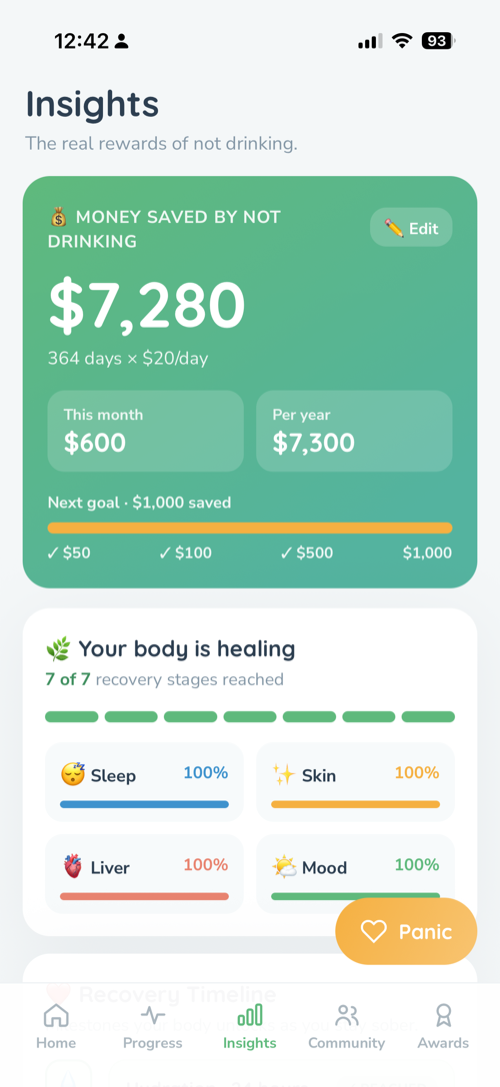
The four fields above, kept in sync without you doing the arithmetic:

Six criteria, then which app does each one well. Ours included, honestly.
A free calculator for your real number, week, month and year.
Structure beats willpower: the complete guide.
Free to download, with a free trial for new members. You're not alone in this.