📱
Comparison
Best sobriety tracking apps in 2026
Six criteria, then which app does each one well. Ours included, honestly.
If you're looking for an I Am Sober app alternative, start with what you want more of. I Am Sober is built around a daily pledge and an evening review, with a big community and a workbook of prompts. It's good at that. What it doesn't describe is a guided plan where each day of your first month has its own focus. SoberLine, ours, is built around exactly that: a 30-Day Recovery Path in three phases, plus a day counter, streak, calendar and an anonymous community, in a calm and simple app. And where I Am Sober covers any addiction, SoberLine is built only for alcohol, so every part of it is about drinking.
Looking for an I Am Sober app alternative usually means one of two things. Either something about the app isn't clicking for you, or you've heard about other approaches and want to know if one fits better. We make one of the apps on this page, so read our take with that in mind. We describe I Am Sober from its own App Store listing and website, and we say where it's the better choice.
I Am Sober is one of the most popular sobriety apps there is, it covers any addiction rather than only alcohol, and it's updated almost every week. From its own description:
It runs on iPhone, Apple Watch, Mac and Android. If the morning pledge gives your day a shape, and reading other people's stories keeps you going, it's a very solid choice.
A daily pledge is a ritual you repeat. Day 3 and day 23 look the same: you pledge in the morning, you review at night. For a lot of people that sameness is the point. It turns not drinking into a habit you don't have to think about.
For others, especially in the first month, it isn't enough. The first week is about cravings and bad sleep. The second and third are about empty evenings and triggers you hadn't noticed. By the fourth week the crisis feeling fades, and that's when "just one" starts to sound reasonable. Those are different problems, and they need different things on different days. We cover what happens to your body over those weeks in a separate guide.
SoberLine's 30-Day Recovery Path is built around that shape. It runs in three phases (stabilize, build skills, integrate), with short daily lessons, curated videos and guided journaling along the way. You open the app and it tells you what today is for. I Am Sober's listing and website don't describe a phased, day-by-day program like this. Its workbook is organised by theme, which is great for working through on your own time, but it's a different thing from a plan that walks you through the month in order.
I Am Sober is made for any addiction, and that breadth is a real strength if you're stopping more than one thing. The trade-off is that a general app has to stay general. The same screens have to work for someone quitting alcohol, nicotine, gambling or something else entirely.
SoberLine only does alcohol, and that shows up in the details:
If alcohol is the only thing you're dealing with, an app that is about nothing else tends to feel like it gets you. If it isn't, I Am Sober's wider scope is the better fit.
It's worth clearing this up, because a lot of comparisons get it wrong. You don't have to give anything basic up by switching. Both apps have:
So the choice isn't about features on a checklist. It's about how the app guides you and how it feels to open it every day.
I Am Sober's column comes from its own App Store listing and website.
| I Am Sober | SoberLine | |
|---|---|---|
| How it guides you | Daily pledge and evening review; workbook organised by theme | 30-Day Recovery Path in 3 phases, with daily lessons, videos and journaling |
| Counting days | Day tracker, milestones | Day counter, streak, calendar view, 22 milestones |
| When a craving hits | Log the urge, coping exercises | Panic Button: 4-4-4 breathing, urge surfing, reflection, distraction games |
| Community | Large community and groups | Anonymous community, plus one tap to text your support person |
| Seeing progress | Money and time saved | Recovery Tree, money saved, 7-stage health timeline |
| Built for | Any addiction | Alcohol only: quit completely, or cut down with a daily limit |
| Platforms | iPhone, Apple Watch, Mac, Android | iPhone and iPad only right now |
This is ours, so weigh it accordingly. Besides the 30-Day Path, SoberLine is deliberately calm and uncluttered. The home screen is your day counter and a Recovery Tree that grows from a seed as your alcohol-free days add up, with everything else a tap away. When a craving hits, the Panic Button takes you through breathing and urge surfing for the 10 to 20 minutes it usually lasts. If you slip, the counter restarts but your milestones, savings and history stay. And if you're cutting back rather than quitting, you can set a daily limit instead.
Honest limits: iPhone and iPad only, no Android and no Apple Watch app. It's built for alcohol only, so if you're also quitting something else you'll need a second app. No pledge ritual, if that's the part you love.
Nomo runs a separate clock for each habit and lets you share them with accountability partners. If you're quitting more than one thing, it handles that better than either app above. We wrote a full look at Nomo too.
If what you're after is a social life, with events and people to meet, Loosid is built for that first. A tracking app won't replace it.
If you open it every morning and it helps, that's the whole job of an app like this. Don't switch for the sake of it.
Write down your sober date before you install anything new. Every sobriety app lets you set a start date in the past, so your days carry over. Your pledges, journal entries and community posts stay in I Am Sober, so there's no rush to delete it. It's also worth keeping a record outside any single app: your date, your reasons and a rough money figure.
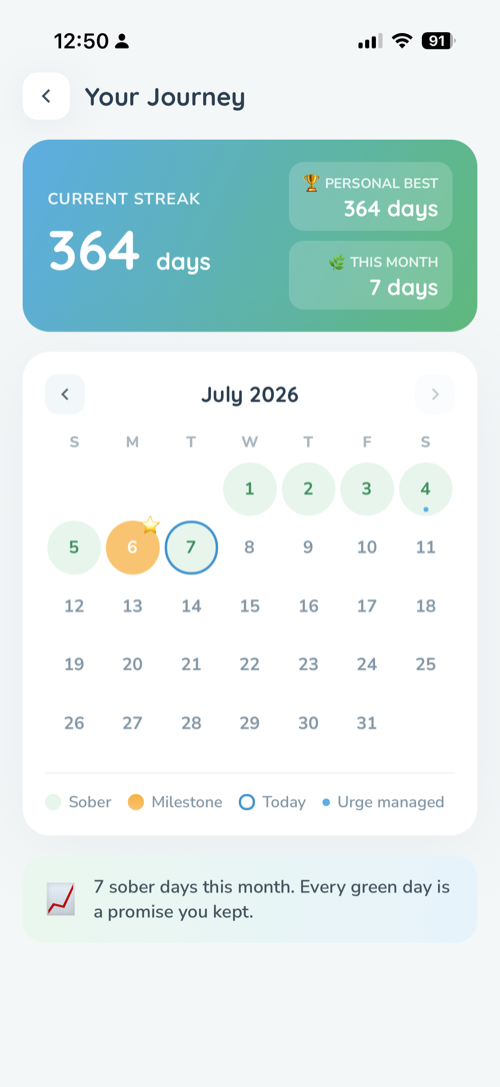
If you want an app that walks you through the month instead of repeating the same check-in, this is the screen:
Six criteria, then which app does each one well. Ours included, honestly.
What Nomo does well, and which app fits if you want a guided first month.
Month two is the predictable risk point, and almost nobody plans for it.
Free to try. You're not alone in this.