📱
Comparison
Best sobriety tracking apps in 2026
Six criteria, then which app does each one well. Ours included, honestly.
Most people looking for Nomo alternatives aren't unhappy with Nomo. They want something it doesn't try to be. Nomo is a toolbox of sobriety clocks for any habit, with accountability partners and quick Refocus exercises. If that's what you need, keep it. If you're quitting alcohol specifically and want to be guided through the first month, day by day, look for an app with a structured plan. SoberLine, ours, is built only for alcohol, around a 30-Day Recovery Path in three phases, with a calm, simple screen and a Panic Button for cravings.
If you're searching for Nomo alternatives, it helps to be clear about what you'd be replacing, because Nomo does a lot of things well. We make one of the apps on this page, so weigh what we say about it with that in mind. We've tried to describe Nomo from its own App Store listing and website, and where Nomo is the better fit, we say so.
Nomo has been around for years. It was built by one person in recovery, and it's still actively updated. From its own description, it gives you:
It runs on iPhone, iPad, Mac and Android. For someone tracking several habits at once, or someone whose recovery leans on a couple of trusted people, it's one of the best tools in the category, and we'd say that even if we didn't make an app.
The reasons we hear come down to three things, and none of them are complaints about Nomo doing its job badly:
If none of those sound like you, you probably don't need an alternative. If one of them does, here's what to look for.
The first month of quitting drinking is when most attempts are won or lost, and it's also the stretch that has the most predictable shape. Days one to seven are about getting through cravings and broken sleep. The second and third weeks are about the empty evenings and the triggers you hadn't noticed. Around week four, the crisis feeling fades, and that's exactly when "one won't hurt" starts to sound reasonable. We go through what happens to your body over those weeks in a separate guide.
SoberLine's 30-Day Recovery Path is built around that shape. It runs in three phases (stabilize, build skills, integrate), with short daily lessons, curated videos and guided journaling along the way. You open the app and it tells you what today is for. Nomo's listing and site don't describe a day-by-day program like this. That's not a flaw in Nomo. It's a different idea of what an app should do, and it's the main reason to choose one over the other.
Both apps count your days and both have other people in them. The table below is about the things that actually differ. Nomo's column comes from its own App Store listing and website.
| Nomo | SoberLine | |
|---|---|---|
| Guided day-by-day plan | None described; built as a toolbox | 30-Day Recovery Path in 3 phases, with daily lessons, videos and journaling |
| What it tracks | Unlimited clocks, any habit | Alcohol, with a goal to quit completely or cut down |
| Counting days | Clocks and milestone tokens | Day counter, streak, calendar view, 22 milestones |
| When a craving hits | Refocus exercises and mini-games; alert your partners | Panic Button: 4-4-4 breathing, urge surfing, reflection, distraction games |
| Other people | Accountability partners, encouragement wall | Anonymous community, one tap to text your support person |
| Seeing progress | Clocks, money saved | Recovery Tree, money saved, 7-stage health timeline |
| After a slip | Reset a clock | Counter restarts; milestones, savings and history stay |
| Platforms | iPhone, iPad, Mac, Android | iPhone and iPad only right now |
This is ours, so weigh it accordingly. Beyond the 30-Day Path, SoberLine is deliberately calm and uncluttered: your day counter and a Recovery Tree that grows from a seed as your alcohol-free days add up, with the rest a tap away. When a craving hits, the Panic Button walks you through breathing and urge surfing for the 10 to 20 minutes it usually lasts. The community is anonymous, with no real names. If you slip, the counter restarts but your milestones, savings and history don't disappear. And if you'd rather drink less than stop, cut-down mode lets you set a daily limit instead.
Honest limits: iPhone and iPad only, no Android. It tracks alcohol, not several habits. No accountability-partner clocks like Nomo's.
I Am Sober is built around a daily pledge in the morning and a review at night, with a workbook of guided prompts and a large community. If the morning and evening check-in is the part of Nomo you like most, I Am Sober takes that idea further. We've written a separate comparison of I Am Sober as well.
If you're quitting alcohol and something else at the same time, Nomo's parallel clocks are the better tool, and there's no reason to switch. Some people use Nomo for the other habits and a dedicated alcohol app alongside it.
Write down your sober date from Nomo before you install anything. Every sobriety app lets you set a start date in the past, so the count carries over. Your tokens and partner history stay in Nomo, which is a good reason not to delete it in a hurry. It's also worth keeping a record that doesn't live in any one app: your date, your reasons, a money figure. Those survive any switch.
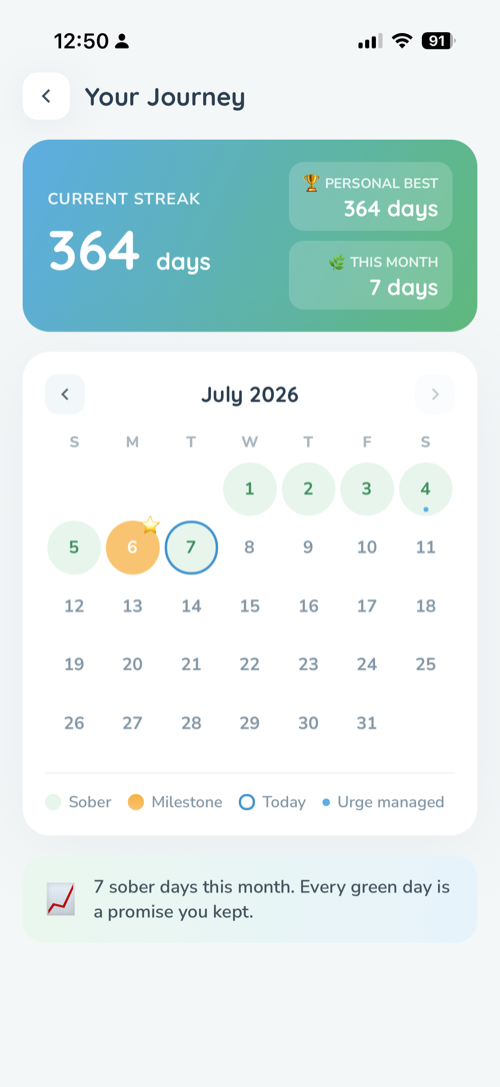
If you want an app that tells you what today is for, this is the screen:
Six criteria, then which app does each one well. Ours included, honestly.
A daily pledge or a guided 30-day path: which one fits your first month.
Days are the easy part. What else is worth writing down, and why.
Free to try. You're not alone in this.