⚖️
Moderation
How to cut back on drinking (without quitting completely)
Moderation is a skill with rules. Here's how to set yours.
How to do Dry January, in one line: start before day 1. The people who finish a dry month don't out-willpower everyone else. They prepare before day 1, script their weekends, replace the ritual (not just the drink), and track what improves so the month pays them back. And one more thing: any month works. The calendar doesn't care. January just has company.
First tip, free of charge: you don't need January. A dry month works exactly the same in March, July or October. January just comes with company, a hashtag and cheaper gym memberships. So whether you're reading this on New Year's Eve or on a random Tuesday in summer, everything below applies. Thirty-one days is thirty-one days.
What separates the people who reach day 31 from the people who quietly stop counting around day 9 is rarely grit. It's preparation. Finishers set the month up before it starts, script the hard moments in advance, and measure the results. Here are the twelve tips that do the heavy lifting.
Dry January has no rulebook, which sounds freeing and turns out to be the problem. Most of the arguments people lose with themselves on day 9 are really arguments about what counts, and those are much easier to settle on day 0. Decide these three before you start.
That's the whole rulebook. Everything else on this page is about making it easier to keep.
"Everyone else is doing it" will carry you to about day 6. A written reason carries you further: better sleep, a clearer head, curiosity about what your evenings look like without a glass in them, a number on a savings goal. Write it somewhere you'll see it on a hard night, because that's the only night it matters. Vague intentions produce vague months.
Before day 1, get the alcohol out of your home: give it away, box it up, put it somewhere that requires effort. This isn't about trusting yourself; it's about physics. A craving that has to put on shoes and walk to a shop is a craving with a built-in cooling-off period. The half-open bottle on the counter offers no such pause.
A dry month announced is a dry month with witnesses. Tell your partner, your group chat, the friends you usually drink with. Public commitment works for an unglamorous reason: it converts a private negotiation ("does tonight really count?") into a public fact ("I'm doing a dry month"). It also recruits allies: most people are far more supportive than you expect, and a few will quietly join you.
The single most common way a dry month ends is an unplanned Saturday. Five weekends, ten opportunities for "nothing to do" to drift toward the old default. Before the month starts, put something in the calendar for each one: a hike, a morning market, a film, dinner where the food is the point. It doesn't need to be impressive. It needs to be decided, because a craving loves a vacuum.
Much of drinking is ritual: the specific glass, the cap coming off, the first sip while dinner cooks. Replace the ritual, not just the drink. Stock alcohol-free beers, decent tonics, bitters and soda: whatever you'd genuinely reach for, not whatever's virtuous. Pour it in the proper glass at the usual time. If the alternative feels like punishment, you'll negotiate with it. If it feels like a drink, you won't.
Mark every alcohol-free day, from day 1. This sounds trivial and is anything but: a visible streak turns an abstract challenge into a running score, and by day 10 the streak itself becomes a reason not to drink, and nobody wants to torch a number they built. A calendar filling up with marked days is the cheapest motivation you will ever own.
Somewhere between day 8 and day 12, most people hit a flat patch: the novelty is gone, the new habit hasn't set, and a bored little voice suggests you've "basically proved the point already." You haven't. You've reached the point where the proving starts. Plan for this window specifically: schedule something good in it, book the dinner, line up the film. And remind yourself that beneath the boredom, your body is doing some of its best repair work of the month: better sleep architecture, steadier energy, a calmer gut. The dip is a phase, not a verdict.
Cravings during a dry month are normal, expected, and (this is the crucial part) short. A single urge typically builds, crests and passes in about 3-10 minutes. So your plan only needs to cover ten minutes: slow breathing to bring the peak down, something absorbing to occupy your attention, a change of room or a walk outside. Decide the sequence before you need it; a craving is a terrible time to improvise. For the full toolkit, see how to stop alcohol cravings in the moment.
You don't have to hide for a month. You need two scripts and one bar tactic.
"I'm doing a dry month" ends most conversations on the spot: it's time-boxed, self-explanatory, and nobody argues with a challenge the way they argue with a lifestyle. Keep a second line for the persistent: "I'm driving" or "early start tomorrow" both work without a debate. And at the bar, order first. The first order sets the table's default; once you're holding an alcohol-free beer, you've left the conversation entirely. Order last and you're choosing against the current with five people watching.
Every skipped round is real money, but only if you can see it. Tally what you'd normally spend in a week, then watch the total climb. Better yet, move it into a separate pot and name it after something you actually want. A number that grows every day is a second scoreboard working alongside your streak. Curious what a month, or a year, adds up to? Run yours through how much money you save by not drinking.
A slip is data, not a failed month. It tells you exactly where your plan has a gap: which evening, which company, which mood. Note it, patch the gap, and restart the same day: not Monday, not next January. The math is unambiguous: a month with 28 alcohol-free days and one slip beats an abandoned month by 28 days. The only real failure mode is using one drink as permission to write off thirty.
Around day 25, with the clearest head you've had in a while, decide what happens next. Keep a few of the rules that served you, like alcohol-free weekdays or no drinking at home? Run another month? Simply return to drinking and notice what's different? All three are wins. The only losing move is letting February decide for you at the first happy hour. If moderation is the goal, how to cut back on drinking turns your month's data into a workable set of rules. And if the month stirred bigger questions than you expected, that has a name too, sober curious, and no deadline attached.
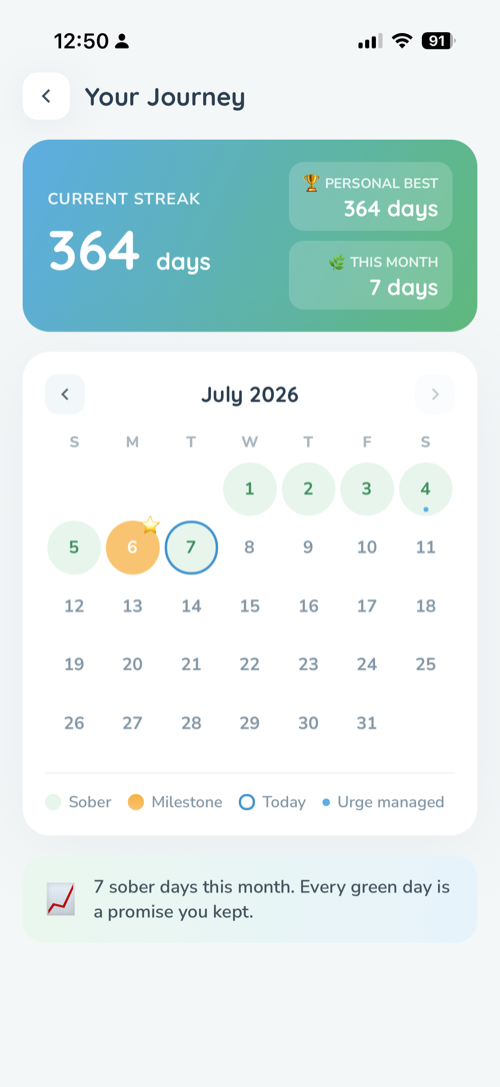
A dry month is mostly a tracking problem wearing a willpower costume. SoberLine hands you the scoreboard:

Moderation is a skill with rules. Here's how to set yours.
Drinking less without a label, a rock bottom, or a lecture.
From the first 24 hours to a full year: what your body repairs, and when.
Free to try. You're not alone in this.