⚖️
Moderation
How to cut back on drinking (without quitting completely)
The rules-based version of the same instinct: limits that actually hold.
What is sober curious? Being sober curious means deliberately questioning your relationship with alcohol, choosing when and whether to drink consciously instead of by default, without needing a problem, a diagnosis, or a permanent commitment to quitting. Sober curious people experiment with drinking less or not at all, and pay attention to what changes.
Maybe you saw the phrase in a friend's bio, or noticed that your local bar suddenly stocks three kinds of non-alcoholic beer. Or maybe it showed up as a quiet 7 a.m. thought: do I actually enjoy this, or do I just do it? That thought, held with curiosity instead of alarm, is the whole movement in miniature.
There are two ideas hiding inside those two words, and both matter.
Curiosity, not rules. Sober curiosity isn't a program with steps or a pledge with a start date. It's a question you carry around: what is alcohol actually doing for me, and to me? You answer it the way any good scientist would: by running small experiments and watching what happens. There's nothing to fail, because a skipped drink and an unskipped one both produce data.
Conscious choice, not default. Most drinking isn't really decided. It arrives with the situation: someone hands you a glass at a wedding, the waiter asks "wine with that?", Friday means beers because Friday has always meant beers. Being sober curious means noticing those autopilot moments and choosing on purpose: sometimes yes, sometimes no, but always you making the call rather than the calendar, the crowd, or the habit making it for you.
That's it. No label to adopt, no identity to defend, no minimum commitment. You can be sober curious for a month, a season, or the rest of your life, and you can drink during any of it.
The phrase was popularized by writer Ruby Warrington, whose 2018 book Sober Curious gave a name to something a lot of people were already quietly doing: questioning default drinking without identifying as someone with a drinking problem. The idea landed at the right moment: non-alcoholic beers, wines and spirits were getting genuinely good, dry-month challenges were going mainstream, and wellness culture had made "how does this make me feel?" a normal question to ask about anything you put in your body. The movement grew from there, less as an organization and more as a shared permission slip.
These three terms get tangled together, and untangling them respectfully matters.
No gatekeeping runs in either direction. You don't have to hit a bottom to be allowed to question your drinking, and choosing curiosity doesn't minimize anyone else's recovery. Different doors, same building: a more deliberate relationship with alcohol.
Curiosity needs experiments, and the classics are classics because they work:
If you'd rather have structure than open-ended curiosity, the same instinct also comes in a rules-based flavor. See how to cut back on drinking without quitting completely.
Everyone's data comes out different, but a few findings show up again and again. Many people report sleep improving within a week or two. Alcohol helps you fall asleep but fragments the second half of the night, so alcohol-free evenings often produce noticeably better mornings. Many notice the money: individual drinks feel cheap, but a month of them rarely is, and watching the total accumulate is its own kind of education. And almost everyone reports a stranger discovery: how much of their drinking was social autopilot. The rounds you didn't order, the toasts you didn't need, the parties that were exactly as fun. If you're curious what an alcohol break does physically (to sleep, skin, liver, blood pressure), there's a full week-by-week timeline of what happens when you stop drinking.
You do not need to have made a decision to get most of the benefit. Three alcohol-free living tips do the heavy lifting during the curious phase: give the evening slot a default activity so it is not re-decided every night, sort out what actually goes in the glass before the first social event rather than during it, and write down one line a week on what you notice. The last one matters most — the changes are gradual enough that memory alone will tell you nothing happened. If the curiosity turns into a decision, what holds past the first month is a different problem again.
You don't need a January or a Monday. Three tiny experiments, pick one:
And if somewhere along the way the question sharpens, if you find you don't just want to study alcohol but to be done with it, that's a different project with its own map: a realistic 7-step plan for stopping.
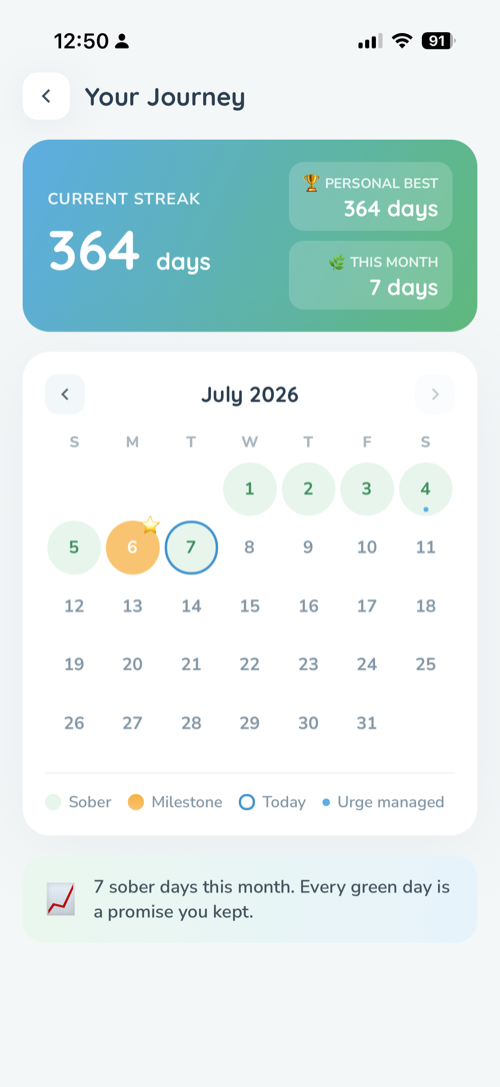
Every experiment needs a lab notebook, and that's exactly what SoberLine is for sober curiosity, a quiet place to run the experiment and actually see the results:

The rules-based version of the same instinct: limits that actually hold.
The classic structured experiment, and how to get the most out of it.
If curiosity turns into a decision, structure beats willpower.
Free to try. You're not alone in this.